

























SHOP NOW:


Designing a pizzeria takes much more than choosing an oven and a few utensils. You need to think about workflow, product quality and how service times are managed. A well-equipped, well-organised pizzeria lets you optimise production and turn out perfect pizzas every time, even at the busiest moments.
The differences between a traditional pizzeria, a modern pizzeria and a dark kitchen have a major impact on equipment choices and on how the kitchen is organised. A traditional pizzeria focuses on table service and the dining experience, while a dark kitchen concentrates solely on production and fast dispatch, usually for delivery and takeaway. Dough handling, refrigeration and the pizza line also change according to the business model and production volumes.
Professional equipment plays a key role: from dough quality to baking and ingredient storage, every technical choice has a direct effect on output, consistency and customer satisfaction. That is why choosing the oven, mixer or pizza counter one by one is not enough: you need to design an efficient working system that keeps operations flowing, fast and organised throughout service.
Discover our full range of professional pizzeria equipment
Discover our professional pizza ovens
Discover our pizza dough containers
SHOP NOW:
Modern pizzeria and dark kitchen: what do you really need?
A modern pizzeria differs from a traditional one in its optimised production flow, modular use of space and more efficient, versatile equipment. It often integrates digital systems for order management and quality control.
A dark kitchen is built for delivery and takeaway. It has no dining room or table service, but it must guarantee speed, consistent product and temperature retention during transport. This model is growing fast, especially in cities with a high density of deliveries.
The workflow changes with the business model. In a modern pizzeria, production follows the sequence: dough → shaping → topping → baking → cutting → service/delivery. In a dark kitchen, some stages focus on efficient packaging and transport, without sacrificing quality.
It is important to design an efficient "pizza production line", with dedicated areas for dough, topping, baking and packaging. The essential equipment includes:
- Pizzeria dough mixers
- Refrigerated pizza counters
- Pizza dough ball containers
- Refrigerated ingredient display cases
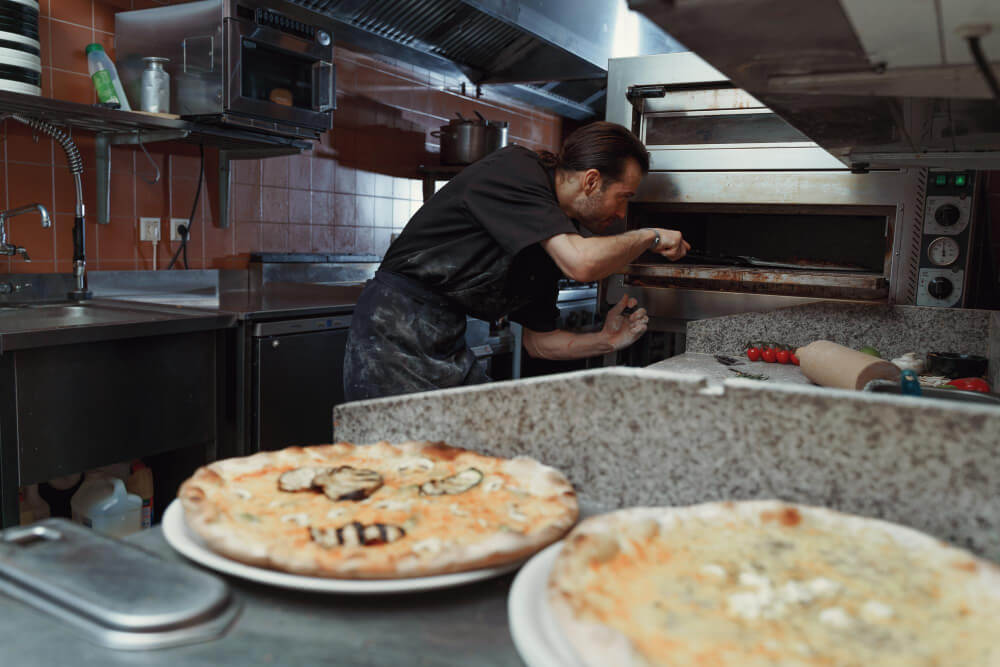
Essential equipment for a professional pizzeria
Professional pizza oven: which one to choose?
The right oven depends on the type of pizza, production volumes and the layout of the space. Electric ovens are ideal for compact pizzerias and offer precise temperature control. Gas ovens heat up quickly and suit medium to high production, while conveyor (tunnel) ovens deliver high output for dark kitchens or delivery operations.
Many pizzerias underestimate how much the oven really affects organisation and continuity of production. Changing oven means changing how baking is managed, the speed of service and production capacity at peak times. In contemporary pizzerias, professional electric ovens are often chosen for their precise temperature control and consistent baking.
Browse our professional pizza ovens category
Also read our guide to Fimar pizza ovens
Dough mixers, dough sheeters and dough containers
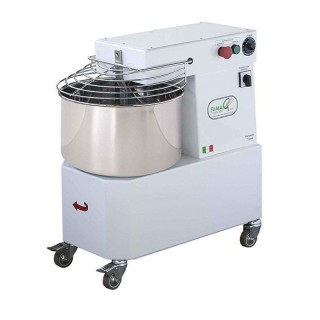
Dough mixers can be planetary, spiral or fork mixers. Each type has its own advantages: spiral mixers for high-hydration doughs, planetary mixers for small batches. In modern pizzerias, the choice of mixer also directly affects how work is organised, production times and dough management during the busiest services.
Proving the dough in suitable containers is essential for quality, consistency and smooth operations. Contemporary high-hydration doughs need closer temperature control, careful storage of dough balls and a well-organised pizza line.
Discover:
Pizza dough proving containers
Professional dough mixers
Refrigerated pizza counters and ingredient storage
A stainless steel refrigerated counter with chilled ingredient wells keeps ingredients fresh and within easy reach. Refrigerated worktops combine working space and storage, improving productivity and food safety.
Browse our refrigerated pizza counters section.
How should you organise the pizza counter to speed up service?
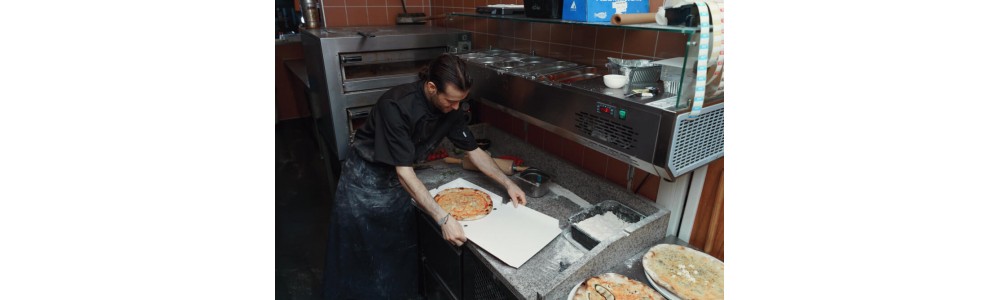
The pizza counter is the operational centre of the production line. A poorly organised layout of ingredients and toppings slows the pizza chef down and adds unnecessary movement during service.
Professional pizza counters improve organisation, speed and ergonomics, keeping dough balls and ingredients within easy reach even at the busiest times.
Discover our professional pizza counters
Essential tools for professional pizza making
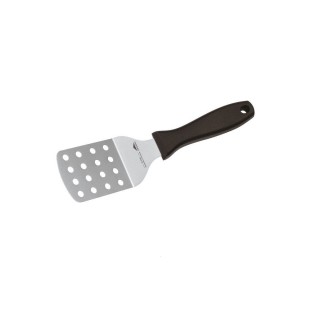
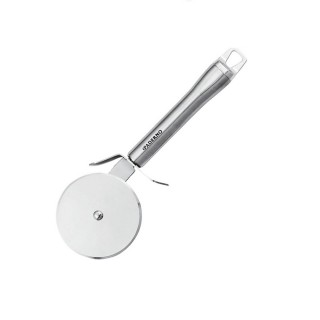
Essential tools include pizza peels, pizza cutters, baking trays, racks and a professional mozzarella cutter. Every tool contributes to speed of service and the quality of the finished product.
Visit:
How to design the layout of a professional pizzeria
Designing a professional pizzeria should start from the space available and how the equipment will be used. The aim is not just to fit in all the machines you need, but to create an environment where every station has a clear function and is easy for staff to reach.
The equipment layout must take into account the service model, expected volumes and the number of people working in the kitchen at the same time. The set-up for a small takeaway pizzeria can be very different from the one needed for a business with a dining room, delivery and high production.
Which areas should the design include?
Before choosing individual pieces of equipment, it helps to identify at least the main working areas:
- dough preparation area;
- area for handling and storing dough balls;
- pizza preparation station;
- baking area;
- service, takeaway or packaging area.
The final layout must be adapted to the premises and to the way you work. The principle is simple: the most frequently used equipment must be easy to reach, and the layout must let staff work without getting in each other's way.
For a detailed look at how to organise the pizza station, see our guide:
How to organise the pizza line in a professional pizzeria.
How does equipment differ between a traditional pizzeria, takeaway and dark kitchen?
The service model has a direct influence on kitchen design. A pizzeria with table service must handle production and service at the same time, while a takeaway or delivery business needs to pay more attention to preparation speed, packaging and continuity of production.
What equipment does a pizzeria with table service need?
In a traditional pizzeria it is important to create a functional link between preparation, baking and service, while keeping enough working space even at the busiest times.
How does the design of a takeaway pizzeria change?
In a takeaway-focused pizzeria, the space can be organised to prioritise speed and keep production, baking, packaging and dispatch close together.
What changes in a dark kitchen?
A dark kitchen can focus its resources more on production, order management and packaging. Here the equipment must be sized to match production volumes and the way orders are spread across the day.
The principle remains the same, however: the type of business should drive the choice of equipment, not the other way round.
Examples of pizzeria equipment set-ups
The equipment set-up changes with the size of the premises, the service model and expected volumes. The examples below are not mandatory configurations, but they help show how the level of equipment in a professional kitchen can vary.
Modern pizzeria start-up on a limited budget
- Compact professional mixer
- Stainless steel work table
- Professional electric oven
- Essential tools for preparation and baking
- Dough containers
Professional pizzeria with mixed service
- Professional spiral mixer
- Refrigerated pizza counter
- Professional oven sized for the expected volumes
- Refrigeration and ingredient storage equipment
- Professional tools and dough containers
Dark kitchen or high-volume pizzeria
- High-capacity professional mixer
- Refrigerated counters and ingredient handling equipment
- High-capacity oven
- Automation systems, where needed, for the stages that call for higher productivity
- Packaging and delivery management equipment
The final set-up must be sized to the expected production and the space actually available, avoiding equipment that does not fit the business model.
How much does it cost to equip a pizzeria?
At this point there is only one question left: how much does it cost to put all this together? There is no single figure, because the bill varies enormously with the type of oven, the volumes and how long you are prepared to wait before buying the time-saving equipment. What we can do is give orders of magnitude and, above all, separate two budgets that are almost always confused: the cost of the equipment and the cost of opening, which is a different and much larger figure.
Pizzeria equipment prices: market ranges
These are the price ranges for the main pizzeria equipment on the Italian market, including VAT, for new professional-grade products. The ranges are wide because each item covers very different models: where it helps, the third column shows what pushes the price up.
| Equipment | Indicative price range | What drives the price |
|---|---|---|
| Electric pizza oven | €500 – €3,500 | number of decks and baking surface |
| Gas pizza oven | €1,500 – €5,500 | decks, power, baking system |
| Wood-fired oven | €4,000 – €15,000 | chamber size, finishes, installation |
| Spiral mixer | €600 – €2,500 | bowl capacity, fixed or tilting head |
| Refrigerated pizza counter | €500 – €3,500 | length, compartments, ingredient wells |
| Refrigerated cabinet | €400 – €3,100 | litres, temperature, double door |
| Cold room | €950 – €4,200 | volume and operating temperature |
| Ingredient display case | €290 – €1,300 | number of pans and refrigeration |
| Blast chiller | €1,200 – €10,000 | number of trays and freezing cycle |
| Pizza dough sheeter | €500 – €1,800 | one or two pairs of rollers, automatic functions |
| Extractor hood | €350 – €1,500 | size, built-in or separate motor |
| Commercial dishwasher | €1,400 – €7,400 | undercounter or hood-type, basket |
| Stainless steel work table | €150 – €1,500 | length, shelves, drawers, sink |
| Commercial sink | €280 – €1,100 | number of bowls and frame |
| Stainless steel wall cabinet | €150 – €900 | length and type of doors |
| Dough containers | €4 – €15 each | size and material |
| Peels, turning peels and utensils | €3 – €150 per item | material and handle length |
Ranges surveyed in September 2026 on new professional-grade products; for wood-fired ovens and opening costs, figures are based on the average values given by the main Italian industry guides. They are orders of magnitude for budgeting, not a quote: the actual set-up depends on space, available electrical power and service volumes.
One thing the comparison makes clear: the item with by far the widest range is the oven, which on its own can be worth as much as the rest of the kitchen, or a tenth of it. That is where much of the budget is decided, and the choice between oven types is covered in detail in our guide on how to choose a professional pizza oven.
Budget for the three set-ups
Going back to the three set-ups described above, these are the orders of magnitude for equipment only, with an electric or gas oven:
| Set-up | Equipment only |
|---|---|
| Start-up on a limited budget: takeaway or small dining room, compact mixer, one oven, refrigerated counter, one work table, sink, undercounter dishwasher, utensils | €12,000 – €18,000 |
| Professional pizzeria with mixed service: spiral mixer, multi-deck oven, pizza counter, refrigerated cabinet, ingredient display case, larger extractor hood, full stainless steel furniture, hood-type dishwasher | €20,000 – €30,000 |
| Dark kitchen or high productivity: all of the above plus dough sheeter, blast chiller, second oven or conveyor oven, cold room, delivery equipment | €35,000 – €55,000 |
A wood-fired oven pushes the first row up by several thousand euros, and it has to be budgeted together with the flue, which is a building job in its own right. Refurbished second-hand equipment also changes the picture considerably, especially for refrigerated cabinets and stainless steel furniture, where wear matters less than on motor-driven machines.
What the equipment cost does not include
This is the part that breaks most budgets, because it never appears in equipment quotes and often costs as much as the equipment itself, if not more:
- Electrical, plumbing and gas installations: a three-phase oven needs a dedicated power supply, and the power available can determine which ovens can actually be installed
- Flue and building work: needed with a wood-fired oven, with design and inspection
- Dining room furniture, signage, till and management software
- Packaging: pizza boxes, containers and takeaway materials, which are a recurring cost rather than an initial one
- Permits, paperwork and professional advice
Putting it all together, Italian industry guides put the cost of opening a takeaway pizzeria at around €50,000 – €80,000, and a pizzeria with a dining room at over €100,000. Equipment is therefore a significant but minority share of the total, which is also why it pays to get a quote for the installations before choosing the machines, not after. Several common mistakes when opening stem precisely from taking these two decisions in the wrong order.
Where to focus your budget
When resources are limited, a sound rule is to distinguish between equipment that determines the product and equipment that saves time. The dough mixer and the oven fall into the first category: they shape every pizza that goes out, and their limitations can rarely be overcome by working better. The pizza counter and the cold chain keep service going at peak times. The dough sheeter, mozzarella cutter and ingredient display case save precious minutes, but they are also the easiest items to add later, once volumes have settled and you know where time is really being lost.
The blast chiller deserves separate consideration: it is useful if you prepare ahead, freeze semi-finished products or run delivery with scheduled production, while in a pizzeria that makes and bakes its dough on the same day it risks being under-used. It is worth assessing against your actual workflow rather than buying it just to complete the kit.
What mistakes should you avoid when designing a pizzeria?
Before buying equipment, it is important to check that the kitchen design matches the business model and the expected volumes. Points to check include the sizing of the machines, the space available and compatibility with the existing installations.
A common mistake is choosing individual pieces of equipment separately without considering how they will need to work together. That is why design should come before purchase.
For a closer look at the most common mistakes when opening, read:
Mistakes to avoid when opening a pizzeria.
Designing a modern pizzeria with the right equipment
Designing a modern pizzeria means bringing together space, equipment, production volumes and work organisation. The choice of oven, dough mixer, pizza counter, refrigeration equipment and dough handling systems should be made as part of a single project.
Before buying the machines, it is therefore useful to define the service model, estimate production volumes, check the available installations and plan the layout of the different stations. This way the equipment can work in a coordinated way and the kitchen can stay efficient even at peak times.
Individual pieces of equipment also deserve specific technical evaluation, which is why Cornerchef provides dedicated guides to dough mixers, ovens, pizza counters, dough ball management and production line organisation.
Good design, then, is not about filling a kitchen with machines, but about building a working system that matches the real needs of the pizzeria.