




















SHOP NOW:
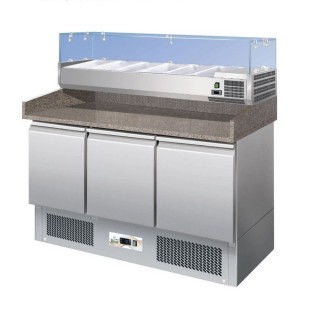



A professional pizza prep counter is one of the most important pieces of equipment in a modern pizzeria because it combines food preparation, ingredient storage, and workstation organization into a single operational unit. Choosing the right model means improving ergonomics, service speed, ingredient preservation, and overall productivity. Dimensions, refrigerated storage capacity, ingredient pan configuration, and production volume are the main factors to evaluate before making a purchase.
When thinking about the essential equipment for a pizzeria, attention is often focused on ovens and dough mixers. In reality, most of the pizza maker's daily work takes place at the pizza prep counter.
This is where pizzas are assembled, ingredients, dough balls, and toppings are managed, and a significant portion of the entire kitchen's productivity is concentrated.
For this reason, a pizza prep counter should not be considered simply a worktable, but a true operational workstation designed to improve efficiency, organization, and service continuity.
Anyone planning to open a new business can also learn more by reading our guide to professional pizzeria equipment, which analyzes the role of the main pieces of equipment in a modern pizzeria.
The professional pizza prep counter is the operational center of pizza preparation and directly affects organization, productivity, and service quality.
SHOP NOW:
What Is a Professional Pizza Prep Counter and Why Is It Different from a Standard Refrigerated Worktable?
At first glance, a professional pizza prep counter may look like nothing more than a refrigerated worktable.
In reality, it is equipment specifically designed to meet the operational needs of pizzerias. The main difference is not refrigeration alone: a pizza prep counter is designed to allow the pizza maker to have everything needed for preparation in a single workstation, from refrigerated ingredients and ready-to-use dough balls to the work surface, gastronorm containers, and organized storage areas that speed up every stage of preparation.
The goal is to reduce unnecessary movement, improve ergonomics, and create a smoother workflow. For this reason, a properly sized pizza prep counter can have a much greater impact on productivity than many people realize.
A professional pizza prep counter combines refrigeration, preparation, and operational organization in a single workstation.
Why Is the Pizza Prep Counter One of the Most Important Pieces of Equipment in a Pizzeria?
Many businesses only realize after opening how much the pizza prep counter affects daily operations.
A workstation that is too small, poorly organized, or unsuitable for production volumes can create continuous delays that ultimately impact the entire service.
Conversely, a properly sized counter makes it possible to:
- keep ingredients always within easy reach;
- reduce unnecessary movement;
- improve preparation speed;
- maintain a more organized workstation during service;
- make operators' work easier.
These advantages become particularly evident during peak service hours, when just a few seconds saved on each pizza can make a significant difference in the total number of pizzas prepared.
It is no coincidence that many of the operational efficiency principles discussed in our guide to increasing productivity in a pizzeria begin with the proper design of the workstation itself.
A pizza prep counter suited to your production volume helps improve speed, organization, and operational continuity.
Refrigerated Pizza Prep Counter: What Are the Real Advantages?
Today, most professional pizzerias use refrigerated pizza prep counters because storing ingredients directly beneath the workstation reduces handling time while making it easier to maintain the cold chain.
Tomato sauce, mozzarella, cured meats, vegetables, and other ingredients remain immediately available throughout service without forcing staff to repeatedly walk to refrigerators or cold rooms. Beyond operational convenience, this solution also offers organizational and hygienic advantages: ingredients remain better organized, easier to access, and properly preserved throughout the entire service.
The refrigerated ingredient rail for gastronorm pans also ensures that the most frequently used toppings are always within easy reach.
A refrigerated pizza prep counter improves organization, preparation speed, and proper ingredient preservation.

There Is No Perfect Pizza Prep Counter for Every Pizzeria
One of the most common mistakes is trying to find the model considered the "best" overall. In reality, the ideal pizza prep counter depends on the specific business.
A small takeaway pizzeria producing only a few dozen pizzas per day has completely different requirements from a contemporary pizzeria serving hundreds of guests or a business primarily focused on delivery.
Before evaluating models, brands, and configurations, it is essential to analyze:
- average number of pizzas produced;
- size of the production area;
- number of operators working on the pizza line;
- type of service;
- number of ingredients handled during service.
The choice of pizza prep counter should always begin with these factors rather than focusing exclusively on price or the available space.
The choice of a pizza prep counter should always be proportional to production volumes and the actual organization of the pizzeria.
The Relationship Between the Pizza Prep Counter and Pizza Line Organization
A pizza prep counter never works in isolation but is part of a broader system that includes dough preparation, storage, assembly, and baking. For this reason, its effectiveness also depends on how it is integrated into the production line.
A well-designed workstation allows the pizza maker to work with smooth, natural movements while minimizing interruptions and unnecessary movement. Conversely, poor layout planning can eliminate many of the advantages offered by even the best pizza prep counter available on the market.
This topic is closely related to what we discussed in our guide to pizza line organization, where we analyzed how to design an efficient workflow from dough preparation to baking.
The value of a pizza prep counter also depends on how effectively it is integrated into the pizzeria's production line.
What Should You Evaluate Before Buying?
Before choosing a professional pizza prep counter, it is important to understand that not all features carry the same weight.
Dimensions, number of refrigerated doors, refrigerated capacity, ingredient pan configuration, materials, and internal organization can all significantly affect everyday use.
In the next section, we will analyze the main selection criteria in detail and explain how to correctly size a pizza prep counter according to your business's production volume.
How to Properly Size a Professional Pizza Prep Counter
One of the most common mistakes is choosing a pizza prep counter based solely on the available space in the premises. Although the size of the production area is an important factor, the real selection criterion should be the daily workload the workstation is expected to handle.
An undersized counter can create continuous organizational issues: ingredients spread across multiple locations, unnecessary movement, limited workspace, and difficulties managing preparation during peak service periods. Conversely, a properly sized workstation allows operators to work with greater organization, speed, and continuity, improving the overall efficiency of the service.
To make the right choice, it is useful to start by evaluating the expected production volume.
Type of Business |
Estimated Production |
Recommended Configuration |
Small takeaway pizzeria |
Up to 80–100 pizzas/day |
2-door counter with refrigerated ingredient rail |
Traditional pizzeria |
100–250 pizzas/day |
2- or 3-door counter with a large work surface |
Contemporary pizzeria |
250–500 pizzas/day |
3-door counter with high refrigerated storage capacity |
Delivery and high-volume operations |
More than 500 pizzas/day |
Modular counter or multiple dedicated workstations |
Naturally, every business has its own specific requirements, but evaluating production volumes is almost always the best starting point.
The size of the pizza prep counter should be determined primarily by the number of pizzas produced, not just by the available space.
How Many Doors Do You Really Need?
One of the features that most significantly influences the purchasing decision is the number of refrigerated doors. Many operators consider this a secondary aspect, but the internal capacity of the counter directly determines how many ingredients can be stored within easy reach during service.
As a general rule, two-door models are suitable for small and medium production volumes, while three-door models are the most common choice in professional pizzerias thanks to their excellent balance between capacity and footprint. Larger configurations are generally intended for high-volume operations or businesses with multiple operators working on the same production line.
The choice should not depend solely on the number of ingredients used, but also on how frequently the workstation needs to be restocked during service.
A greater number of doors increases operational capacity and reduces the need for continuous restocking during service.
The Importance of Ingredient Pans and the Refrigerated Ingredient Rail
When evaluating a professional pizza prep counter, attention is often focused on the refrigerated cabinet below, while the upper ingredient section is overlooked. In reality, the refrigerated ingredient rail is one of the features that has the greatest impact on workstation ergonomics.
A well-organized layout of gastronorm pans makes preparation faster, keeps the workstation tidy throughout service, reduces unnecessary movement, and improves ingredient management. All of this results in a smoother, more efficient workflow for the operators.
The ideal configuration depends on the number of ingredients permanently included on the menu. A traditional pizzeria has very different requirements from a contemporary pizzeria offering a wide variety of toppings and combinations.
A well-organized refrigerated ingredient rail improves speed, organization, and operational continuity throughout service.
Materials and Build Quality: Why Stainless Steel Remains the Best Choice
In the professional sector, almost all pizza prep counters are made of stainless steel, and the reason is simple: this material provides an outstanding balance of strength, ease of cleaning, and corrosion resistance.
In a professional pizzeria, the counter is exposed every day to humidity, temperature fluctuations, professional cleaning products, accidental impacts, and intensive use. For this reason, build quality should never be considered a secondary detail.
A pizza prep counter is a long-term investment that is expected to last for many years. Choosing high-quality materials and components helps reduce maintenance costs, technical interventions, and premature replacement.
Stainless steel remains the benchmark material for professional pizza prep counters thanks to its durability, hygiene, and long service life.
The Relationship Between the Pizza Prep Counter and Dough Ball Management: An Often Overlooked Connection
Many pizza makers view the pizza prep counter solely as the workstation dedicated to ingredients, but its relationship with dough ball management is much closer than it may seem.
The distance between the dough ball storage area and the operational workstation has a direct impact on workflow efficiency. When the pizza maker must constantly move to retrieve dough balls, productivity inevitably declines and service becomes less efficient.
For this reason, the design of the production line should take into account not only the arrangement of ingredients, but also the position of dough containers and the organization of the fermentation stages.
This topic is closely related to what we explored in our guide to pizza dough ball management, where we analyzed how to optimize the storage, rotation, and use of dough balls during service.
The position of the dough balls in relation to the pizza prep counter directly affects the smoothness of the preparation process.
How Much Should Price Influence Your Decision?
One of the most common searches concerns price. Understandably, every business owner wants to find the solution that offers the best balance between investment and operational benefits.
However, price should never be evaluated in isolation. Two counters that appear very similar may differ significantly in refrigeration quality, internal capacity, stainless steel thickness, energy consumption, component reliability, and workstation ergonomics.
Over the long term, a higher-performing counter can improve workflow organization, service speed, and the overall lifespan of the investment, generating value that far exceeds the initial price difference.
When choosing a professional pizza prep counter, the overall value of the investment matters more than the purchase price alone.
Common Mistake: Choosing a Counter Based on Present Needs Instead of Future Growth
One of the most common mistakes made by new businesses is sizing the pizza prep counter exclusively according to current requirements.
A pizzeria producing 80 pizzas per day today may be producing twice as many within a few months. If business growth is one of the objectives, it may be worthwhile to choose a slightly larger configuration than is immediately necessary.
This approach supports business development without requiring the rapid replacement of one of the most important pieces of equipment in the production area, avoiding additional costs and operational interruptions.
Choosing a pizza prep counter with a moderate amount of extra capacity can prove to be a smart long-term investment.
The Most Common Mistakes When Choosing a Professional Pizza Prep Counter
After analyzing dimensions, capacity, and configurations, it is worth focusing on the mistakes that most frequently lead to an unsatisfactory purchase.
The first is considering the pizza prep counter as merely a piece of furniture or a standard refrigerated worktable. In reality, it is one of the most heavily used workstations in the entire pizzeria, and choosing the wrong model can negatively affect daily operations.
A second mistake concerns sizing. Many businesses choose the smallest possible model to reduce the initial investment or adapt to the available space. This decision can become problematic when production volumes, the number of ingredients, or the number of operators increase.
Refrigeration performance is also sometimes underestimated. A pizza prep counter must provide consistent performance throughout the entire service, especially during the busiest days or in the summer months, when frequent door openings and high ambient temperatures place greater stress on the refrigeration system.
Finally, focusing exclusively on price without considering factors such as reliability, ergonomics, energy efficiency, and build quality is another common mistake. Over time, these are precisely the factors that determine the true value of the investment.
The most common mistakes involve insufficient sizing, underestimated refrigeration performance, and decisions based solely on price.
Professional Pizza Prep Counter: Which Configuration Should You Choose Based on Your Business?
There is no universally correct configuration because every pizzeria has different operational requirements.
A small takeaway pizzeria working with a limited number of ingredients and modest production volumes can operate efficiently with a two-door counter equipped with a refrigerated ingredient rail. In this context, compactness and practicality are often the most important selection criteria.
Traditional dine-in pizzerias generally benefit from larger configurations capable of accommodating more ingredients while providing better workflow organization during peak service periods.
Contemporary pizzerias, characterized by more extensive menus, greater pizza customization, and a larger variety of toppings, usually require greater refrigerated capacity and a more structured ingredient pan layout.
Businesses heavily focused on delivery or very high production volumes may ultimately require modular workstations, large pizza prep counters, or even multiple dedicated production lines.
The correct choice therefore comes from analyzing the actual workflow rather than searching for a one-size-fits-all solution.
The best pizza prep counter is the one that best fits your pizzeria's organization and actual production volumes.
Professional Pizza Prep Counter and Productivity: An Often Underestimated Connection
When discussing productivity, people tend to think immediately of ovens, dough mixers, or automation.
In reality, the pizza prep counter is one of the pieces of equipment that most strongly influences the daily pace of work.
A properly designed workstation allows operators to reduce unnecessary movement, work more efficiently, and keep ingredients and tools constantly within reach. This minimizes interruptions and creates a smoother preparation process.
Conversely, a poorly designed counter can generate small inefficiencies that are repeated hundreds of times during each service. Individually they may seem insignificant, but together they can have a major impact on overall productivity.
For this reason, a pizza prep counter should be considered not merely as refrigerated equipment, but as a true operational organization tool.
Many of the principles discussed in our article on pizzeria productivity are directly applied through the design of the workstation itself.
A well-designed pizza prep counter contributes directly to productivity by reducing downtime and unnecessary movement.
How to Evaluate Value for Money
The question of price is inevitable, but it should be approached from a broader perspective.
The initial purchase cost represents only part of the investment. Equally important are durability, component reliability, energy efficiency, and the counter's ability to support future business growth.
In many cases, a slightly higher-performing model proves to be more cost-effective than a seemingly cheaper solution that is limited from an operational standpoint.
For this reason, the correct approach is not to identify the least expensive counter, but the one that offers the best balance between investment, performance, and future operational needs.
The best value for money does not necessarily mean the lowest price, but the greatest long-term value.
How to Choose the Right Professional Pizza Prep Counter for Your Pizzeria
A professional pizza prep counter is much more than a refrigerated work surface. It is the point where organization, preparation, ingredient storage, and operational productivity come together.
Choosing the right model means carefully evaluating production volumes, the number of operators, the type of service, the quantity of ingredients managed, and the future growth prospects of the business. Only by considering all these factors together is it possible to identify a solution that truly meets the needs of your pizzeria.
The businesses that achieve the highest levels of continuity and efficiency are often those that have carefully designed every stage of the production process, starting with the workstation where the pizza maker spends most of the working day.
A properly sized, reliable pizza prep counter that is correctly integrated into the production line not only improves operational comfort but also contributes directly to service quality and the production capacity of the entire pizzeria.
The choice of a professional pizza prep counter directly affects organization, service quality, and the production capacity of the entire business.
SHOP NOW: