




















SHOP NOW:






Opening a pizzeria requires much more than choosing a great dough recipe or purchasing a professional pizza oven. The most common mistakes that compromise productivity, service quality, and business profitability often involve workspace planning, equipment sizing, and workflow organization. A wrong decision made during the initial planning stage can create inefficiencies that will affect the pizzeria for years. For this reason, it is essential to design the entire production area as an integrated system in which dough preparation, dough ball management, the pizza prep counter, the oven, and service work together seamlessly.
Many entrepreneurs opening a new pizzeria allocate a large portion of their budget to the most visible equipment.
The oven, the interior design, or the overall look of the venue often become the top priorities.
After a few months, however, a different reality usually emerges.
The businesses that perform best are not necessarily those that invested the most, but those that correctly designed their operational workflow.
You can find ovens, mixers and prep counters in our pizzeria equipment category.
The most expensive mistakes when opening a pizzeria are often related to organization, workspace planning, and operational processes rather than to the individual pieces of equipment.
SHOP NOW:
Why Do Some Pizzerias Grow While Others Struggle?
With the same location, ingredient quality, and technical expertise, some businesses grow rapidly while others experience operational difficulties within the first few months.
Very often, the difference lies in the decisions made before opening.
When the production area is designed without an overall vision, every stage of the process tends to create delays.
Over time, these small problems become additional costs, waste, and reduced productivity.
Mistake #1: Buying Equipment Before Designing the Workflow
This is probably the most common mistake.
Many owners start by choosing:
- the pizza oven;
- the dough mixer;
- the pizza prep counter;
- refrigerators.
Only afterward do they try to understand how to organize the workspace.
The correct approach should be exactly the opposite.
First, design the route the pizza will follow throughout the production area.
Only then should you select the equipment that supports that workflow.
Learn more:
Professional Pizzeria Equipment: How to Design a Modern Pizzeria
Equipment should be selected according to the production workflow, not the other way around.
Mistake #2: Underestimating the Importance of Dough Preparation
Many new businesses devote great attention to baking while paying little attention to dough preparation.
In reality, dough is the starting point of the entire production process.
Choosing the wrong dough mixer can create daily problems that affect:
- product quality;
- production capacity;
- organization of the production area.
Learn more:
How to Choose a Professional Dough Mixer: A Guide to Spiral, Fork, and Planetary Mixers
The dough mixer should be sized according to actual production volumes and the expected growth of the business.
Mistake #3: Failing to Plan Dough Ball Management
Many pizzerias correctly design the oven and the pizza prep counter but completely overlook the dough fermentation and storage stage.
This creates problems that become particularly evident during peak service periods.
The most organized businesses plan from the very beginning:
- dedicated storage areas;
- appropriate containers;
- batch management;
- stock rotation procedures.
Learn more:
Pizza Dough Ball Management: The Method Used by Well-Organized Pizzerias to Improve Quality and Productivity
Poor dough ball management can compromise both pizza quality and service productivity.
Mistake #4: Poorly Organizing the Pizza Line
Many entrepreneurs spend weeks choosing equipment but very little time designing the production line.
It is a mistake that often becomes apparent only after opening.
During the first weeks of operation, staff find themselves constantly moving around the production area, crossing the kitchen, searching for ingredients, or waiting for a workstation to become available.
Viewed individually, these delays may seem insignificant.
However, when repeated hundreds of times during a busy service, they become one of the biggest obstacles to productivity.
The most efficient pizzerias design the pizza line according to the natural production workflow:
Dough Preparation → Fermentation → Stretching → Topping → Baking → Service
Learn more:
How to Organize a Pizza Line: The Method Used by Efficient Pizzerias to Work Better
A well-designed pizza line makes it possible to increase productivity without purchasing additional equipment.
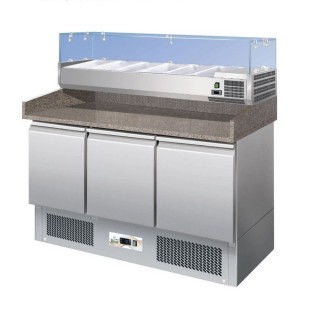
Mistake #5: Choosing the Pizza Prep Counter Without Considering the Type of Service
When purchasing a pizza prep counter, many businesses evaluate only:
- dimensions;
- price;
- number of doors;
- technical specifications.
In reality, the pizza prep counter is one of the most frequently used workstations in the entire production area.
Choosing the wrong model can create daily operational problems:
- insufficient workspace;
- ingredients that are difficult to reach;
- slower preparation times;
- operational difficulties during peak service.
The most organized businesses design the pizza prep counter according to their menu, production volumes, and pizza line organization.
Learn more:
How to Choose a Professional Pizza Prep Counter: A Guide for Traditional, Contemporary, and Delivery Pizzerias
The pizza prep counter should be designed around the pizza maker's workflow rather than simply chosen according to the available space.
Mistake #6: Choosing the Oven Without Considering the Business Model
One of the most expensive mistakes is treating the oven as a purchase independent of the rest of the business.
In reality, the oven should be selected by taking into account:
- the type of pizza;
- the number of seats;
- whether delivery is offered;
- the organization of the production line;
- future growth plans.
A contemporary pizzeria working with high-hydration doughs may have very different requirements from a dark kitchen focused on delivery.
Learn more:
Professional Pizza Oven: A Guide to Choosing Between Electric, Gas, and Conveyor Ovens
The best oven is not the most powerful one, but the one that integrates most effectively with the pizzeria's operational model.
Real Case: An 80-Seat Pizzeria
Let's imagine a new pizzeria with approximately 80 seats.
In this situation, many entrepreneurs tend to oversize certain pieces of equipment while underestimating others.
For example, they may:
- purchase an excessively large oven;
- invest too little in dough ball management;
- pay insufficient attention to the pizza prep counter;
- fail to properly design the production workflow.
The result is often a business that appears very well equipped on paper but generates constant delays during service.
The businesses that achieve the best results at this scale tend instead to prioritize balance and organization.
In small and medium-sized pizzerias, workspace organization often has a greater impact than the size of the equipment itself.
Real Case: A 180-Seat Pizzeria
As the number of seats increases, even small organizational mistakes become much more noticeable.
An unnecessarily long route between the pizza prep counter and the oven may seem insignificant on a quiet evening.
On a busy Saturday night with more than one hundred pizzas to prepare, however, that same route can result in dozens of minutes of lost time.
Pizzerias that regularly handle these production volumes tend to carefully plan every stage of the process:
- dough preparation;
- fermentation;
- stretching;
- topping;
- baking;
- service.
Every area is organized to reduce unnecessary movement and maximize operational continuity.
As production volumes increase, every organizational inefficiency becomes amplified.
Real Case: Delivery Pizzeria and Dark Kitchen
Businesses focused on takeaway and delivery face different operational challenges.
In these environments, customers evaluate not only the quality of the pizza, but also:
- on-time delivery;
- service consistency;
- order accuracy.
For this reason, dark kitchens tend to design their production areas with a strong focus on:
- productivity;
- standardization;
- operational speed;
- simple and efficient workflows.
Very often, the success of these businesses depends much more on organization than on the size of the equipment itself.
In dark kitchens, productivity comes from well-designed processes before it comes from equipment.
Mistake #7: Designing the Pizzeria for the Present Instead of Future Growth
One of the least obvious yet most common mistakes is designing the business solely around its initial requirements.
Many pizzerias open with:
- a limited number of seats;
- a small menu;
- a limited staff.
If the business is successful, however, these conditions can change rapidly.
The most forward-thinking businesses try to anticipate future growth from the very beginning.
This does not necessarily mean purchasing oversized equipment immediately, but rather designing spaces and workflows that can evolve over time.
The most efficient pizzerias design their organization not only for opening day, but also for future growth.
How Much Do These Mistakes Really Affect a Business?
Much more than many people imagine.
The problem often does not become apparent during the first few weeks.
It usually emerges after several months, when production volumes increase and inefficiencies begin to accumulate.
Poor organization can lead to:
- downtime;
- greater operational stress;
- waste;
- difficulties in staff management;
- limitations on future growth.
For this reason, the initial planning stage is one of the most important investments for the future success of a pizzeria.
Correcting an organizational mistake after opening is almost always more expensive than preventing it during the planning phase.
Practical Table: Mistake, Consequence, and Solution
Many of the problems that arise during the daily operation of a pizzeria can be anticipated and prevented during the design phase.
The following table summarizes the most common issues observed when opening new pizzerias.
Mistake |
Consequence |
Solution |
Purchasing equipment before designing the production area |
Inefficient workflow |
Design the production process first |
Underestimating the dough mixer |
Production limitations and inconsistent quality |
Size the equipment according to actual production volumes |
Neglecting dough ball management |
Fermentation and service problems |
Organize storage and rotation correctly |
Poorly organizing the pizza line |
Unnecessary movement and delays |
Design a logical workstation sequence |
Choosing the wrong pizza prep counter |
Lower productivity |
Evaluate the menu, ingredients, and production volume |
Purchasing an oven without a clear strategy |
Higher costs and operational inefficiencies |
Select the oven according to the business model |
Failing to plan for future growth |
Need for costly modifications |
Design expandable spaces and workflows |
Most operational problems in pizzerias originate from planning mistakes made before the business even opens.
The Most Efficient Pizzerias Think in Terms of Systems
When observing businesses that consistently maintain both quality and productivity over time, one common characteristic emerges.
They do not view equipment as separate elements.
The oven, dough mixer, pizza prep counter, dough ball management, and production area organization are all designed as parts of a single integrated system.
It is this overall vision that makes it possible to:
- increase productivity;
- improve service;
- reduce waste;
- simplify staff training;
- better support future growth.
The most successful pizzerias invest not only in the right equipment but also in the proper integration of every stage of the production process.
Behind Every Efficient Pizzeria Is Careful Planning
When customers enter a pizzeria, they see the dining room, the staff, and the pizza served at the table.
They rarely notice the work that took place behind the scenes to properly design the business.
Yet much of the operational success originates from these initial decisions.
The layout of the equipment, workspace organization, dough management, the pizza line, and the baking system determine the pizzeria's ability to operate efficiently every single day.
For this reason, opening a pizzeria is not simply about purchasing professional equipment.
It means designing a production system capable of supporting quality, productivity, and long-term growth.
Businesses that approach this stage methodically reduce mistakes, optimize investments, and build a stronger foundation for the future of their business.
SHOP NOW: