




















SHOP NOW:




An efficient pizza line is an organized system that connects dough preparation, dough ball management, the pizza prep counter, ingredients, the oven, and service into a single workflow. When every stage is properly designed, a pizzeria can increase productivity, reduce errors, speed up service, and consistently maintain pizza quality even during peak business hours. In this guide, we'll explore how to organize a professional pizza line, which mistakes to avoid, and how modern pizzerias design their production areas to work faster without compromising quality.
Many operators believe that productivity depends mainly on the oven or the speed of the pizza maker. In reality, observing the daily operations of the most organized pizzerias reveals a different picture: the difference between a chaotic evening and a smooth service often depends on the layout of the workspace and the way equipment works together.
A pizzeria may own excellent dough mixers, state-of-the-art ovens, and high-quality ingredients, yet still waste valuable time because of unnecessary movement, poorly designed workflows, or workstations arranged without a logical operational sequence.
[{}}
What is a pizza line?
A pizza line is the set of operational areas that transform dough into a finished pizza ready to be served to the customer. It includes dough preparation, dough ball management, stretching, topping, baking, and service.
Although this definition may seem simple, it encompasses one of the most important concepts for anyone managing a modern pizzeria.
Every pizza always goes through the same stages:
- Dough preparation.
- Dough ball fermentation and management.
- Stretching.
- Topping.
- Baking.
- Service or delivery.
When these stages are organized logically, work flows naturally. When they are distributed randomly throughout the production area, staff are forced to move continuously, slowing down service.
Why do some pizzerias produce more with the same equipment?
This is one of the most interesting questions a pizzeria owner can ask.
It is common to see two businesses using:
- similar dough mixers;
- comparable ovens;
- equivalent ingredients;
- staff with similar experience;
yet achieving completely different results.
The explanation often lies not in the equipment itself, but in the organization.
An efficient pizza line makes it possible to increase productivity without purchasing new equipment, simply by reducing unnecessary movement and optimizing the workflow.
Pizzerias capable of handling high production volumes do not necessarily work faster. More often than not, they simply work better.
The fundamental principle: reduce unnecessary movement
When observing a professional kitchen or a well-organized pizzeria, one common characteristic always stands out.
People move very little.
It may seem counterintuitive, but one of the main indicators of efficiency is not how fast people move around the production area, but how many unnecessary movements have been eliminated.
Every time the pizza maker has to:
- cross the production area;
- search for ingredients;
- move containers;
- reach a distant workstation;
valuable time is lost.
Multiplied by dozens or hundreds of pizzas, this inefficiency becomes significant.
The goal of a professional pizza line is not to make the pizza maker work faster, but to enable them to perform fewer movements while achieving the same result.
The ideal pizza line workflow
The most organized pizzerias tend to follow a very similar sequence.
Dough Preparation → Fermentation → Stretching → Topping → Baking → Service
This sequence should also be reflected in the physical layout of the equipment.
The closer the actual route matches the natural production process of the pizza, the greater the operational efficiency.
The Key Areas of a Professional Pizza Line
Dough Preparation Area
This is where dough is prepared and the main raw ingredients are handled.
The most common equipment includes:
- dough mixer;
- scales;
- preparation tables;
- ingredient shelving.
Learn more:
How to Choose a Professional Dough Mixer: A Guide to Spiral, Fork, and Planetary Mixers.
Fermentation and Dough Ball Management Area
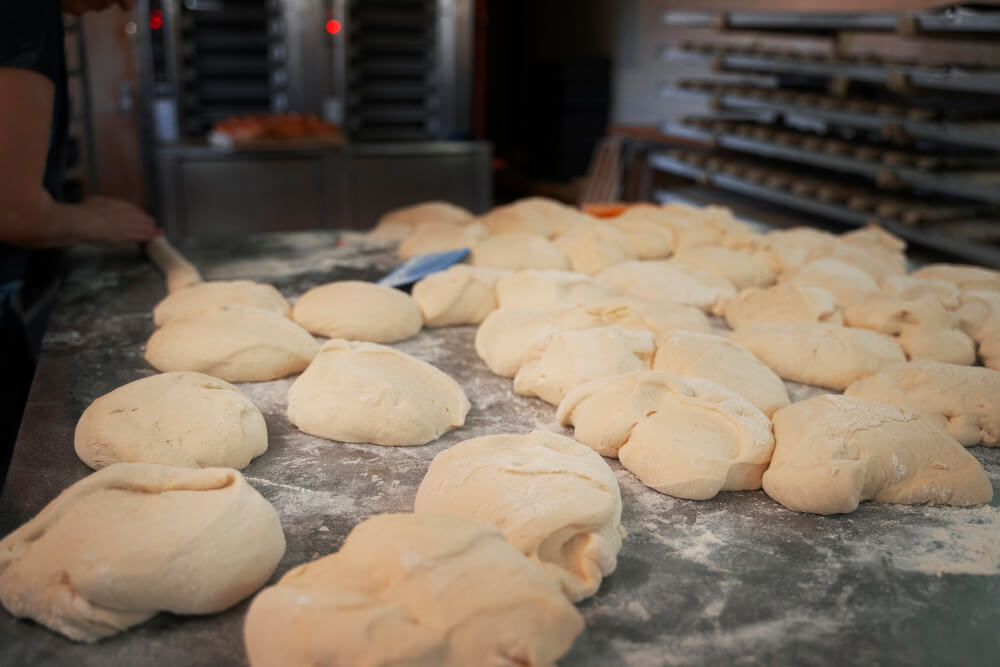
After mixing comes one of the most important stages of the entire production process.
Dough balls must be properly stored and organized to ensure production continuity and consistent quality.
Learn more:
Pizza Dough Ball Management: The Method Used by Well-Organized Pizzerias to Improve Quality and Productivity.
Stretching Area
The stretching station should be located immediately next to both the dough ball storage area and the pizza prep counter. Every additional meter of distance inevitably reduces efficiency during service.
Topping Area
This is the operational heart of the pizza line. Here, the refrigerated pizza prep counter, ingredients, and workstation organization all come together.
Oven Area
The entire production process converges at this point. For this reason, the oven should be easily accessible from the topping station without creating cross-traffic or obstacles.
How much space is really needed for an efficient pizza line?
One of the most common misconceptions is that large spaces are required to work efficiently.
In reality, many highly productive pizzerias operate in relatively compact environments.
An efficient pizza line does not necessarily require more space, but rather a better organization of the available space.
Intelligent workspace design often delivers better results than simply increasing the size of the production area.
Do you need a large kitchen to have an efficient pizza line?
No. Many of the most productive pizzerias operate in relatively small spaces. The real difference is rarely the available floor area, but rather how that space is organized and utilized.
A properly designed production area reduces unnecessary movement, makes operators' work easier, and maximizes every available square meter.
An efficient pizza line depends far more on workspace organization than on the size of the premises.
Table: The Functions of the Main Operational Areas
Stage |
Objective |
Main Equipment |
Dough Preparation |
Prepare the dough |
Dough mixer, scales |
Fermentation |
Dough development |
Dough containers, fermentation cabinets, refrigerators |
Stretching |
Prepare the pizza base |
Worktable |
Topping |
Assemble the pizza |
Refrigerated pizza prep counter |
Baking |
Finish the product |
Pizza oven |
Service |
Deliver to the customer |
Service counter, packaging area |
The Mistakes That Slow Down a Pizzeria the Most
After observing hundreds of pizza production laboratories, the same issues appear time and time again.
Ingredients Too Far from the Pizza Prep Counter
Every ingredient that requires additional movement inevitably slows down service.
Crossing Workflows
When multiple operators share the same workspace without a clearly defined organization, continuous bottlenecks are created.
Dough Balls Stored Too Far from the Stretching Area
One of the most common mistakes made by rapidly growing pizzerias.
Designing the Workflow Only for Quiet Periods
Many pizza lines perform well when there are only a few orders but collapse during peak service.
True efficiency is measured on a busy Saturday evening, not on a quiet afternoon.
How Do High-Volume Pizzerias Organize Their Pizza Line?
One of the most noticeable differences between a pizzeria producing 60–80 pizzas per service and one that regularly exceeds 250–300 pizzas is not so much the quality of the equipment as the level of organization.
As production volumes increase, every inefficiency becomes amplified.
An unnecessary movement that takes just 3 seconds may seem insignificant during a quiet evening. However, if repeated 300 times, it results in more than 15 minutes of lost work.
Pizzerias handling large production volumes tend to design their pizza line according to three fundamental principles:
- reduce unnecessary movement;
- standardize operations;
- eliminate bottlenecks in the production workflow.
In high-productivity pizzerias, the objective is not to work faster, but to eliminate every activity that slows the workflow.
Real Case: A Takeaway Pizzeria with a High Order Volume
In businesses primarily focused on takeaway and delivery, the most common challenge is not the production capacity of the oven but the simultaneous management of multiple orders.
Many takeaway pizzerias discover that delays occur not during baking but in the stages immediately before and after it. Dough balls that are difficult to locate, ingredients arranged without a logical operational layout, or an undersized packaging area can create bottlenecks that compromise the entire service.
Businesses that successfully manage dozens of simultaneous orders usually organize the pizza line according to one simple principle: each operator should be able to complete most tasks without leaving their workstation.
In takeaway-oriented pizzerias, productivity often depends more on the organization of the pizza line than on the speed of the oven.
Practical Example: Organizing a Pizza Line for a 150–200 Seat Pizzeria
Let's imagine a contemporary pizzeria serving an average of 150 to 200 guests during the weekend.
In this scenario, the operational workflow could be organized as follows:
Zone 1 – Dough Preparation
The dough mixer is placed in a dedicated area, separate from the daily service operations.
This makes it possible to prepare dough without interfering with the rest of the production activities.
Zone 2 – Storage and Fermentation
Dough balls are organized in professional containers that are easy to identify.
The dough trays are stored in refrigerated cabinets following a chronological order.

Zone 3 – Stretching Area
The stretching station is located immediately next to the dough ball storage area.
This allows the pizza maker to retrieve dough balls quickly without crossing the production area.
Zone 4 – Pizza Prep Counter
The pizza prep counter is the operational center of the entire pizza line.
The most frequently used ingredients are positioned in the most accessible locations.
Zone 5 – Oven
The oven is positioned directly next to the pizza prep counter.
The operator can move seamlessly from topping to baking without unnecessary movement.
Zone 6 – Service and Packaging
The finished pizza is transferred directly to the service counter or the delivery area.
This configuration allows the workflow to remain linear and continuous.
Real Case: Organizing a Contemporary High-Hydration Pizzeria
Contemporary pizzerias working with high-hydration doughs have different operational requirements compared to traditional pizzerias.
In these environments, dough ball management becomes even more critical. The fermentation area must be easily accessible and perfectly integrated with the stretching station.
Many contemporary pizza makers prefer to minimize the distance between dough trays, the workbench, and the oven in order to reduce unnecessary handling and movement of the dough.
This approach helps preserve the structure of the dough ball while ensuring greater consistency throughout service.
In contemporary pizzerias, the layout of the fermentation and stretching areas has a direct impact on pizza quality.
How Should the Pizza Prep Counter Be Organized to Reduce Preparation Time?
The pizza prep counter is probably the workstation that has the greatest impact on overall productivity.
Many businesses invest in premium ovens or dough mixers while continuing to lose valuable minutes because of poor workstation organization.
The pizza prep counter should allow the pizza maker to complete most operations without changing position.
To achieve this, it is recommended to:
- place the most frequently used ingredients in the first ingredient wells;
- maintain a consistent ingredient layout;
- avoid overlapping equipment;
- reduce lateral movement.
When the pizza maker knows exactly where every ingredient is located, the workflow becomes faster and more precise.
What Is the Most Important Point of the Pizza Line?
The most important point of the pizza line is generally the connection between the stretching area, the pizza prep counter, and the oven.
This is where most operations performed during service are concentrated.
When these three areas are well connected, the pizza maker can work continuously while maintaining high standards of quality and productivity.
When they are too far apart or organized without a logical workflow, unnecessary movement and preparation times inevitably increase.
The connection between the stretching area, the pizza prep counter, and the oven represents the operational heart of most professional pizzerias.
Why Does Dough Ball Management Directly Affect the Speed of the Pizza Line?
Many business owners consider dough ball management a topic separate from pizza line organization. In reality, the two are closely connected.
A disorganized dough ball management system inevitably creates delays during service.
Learn more:
Pizza Dough Ball Management: The Method Used by Well-Organized Pizzerias to Improve Quality and Productivity
The most organized businesses typically implement:
- batch identification;
- scheduled stock rotation;
- quick access to dough containers;
- strategic positioning of dough trays.
Do Delivery and Takeaway Require a Different Pizza Line?
Absolutely.
A pizzeria focused primarily on table service and a dark kitchen face completely different operational requirements.
Traditional Pizzeria
The main objective is to ensure continuous service for dine-in customers.
Contemporary Pizzeria
The priority is the optimal management of more complex doughs and longer production processes.
Delivery and Dark Kitchen
The primary objective becomes productivity. In these environments, the time between receiving an order and dispatching it is a key performance indicator.
Dark kitchens design their pizza line to minimize the time between preparation and delivery.
For this reason, many businesses dedicate specific areas to:
- packaging;
- order verification;
- courier pickup;
- packaging management.
The Most Common Mistakes Observed in Pizzerias
Analyzing the daily operations of many businesses reveals a number of recurring issues.
Constantly Searching for Ingredients During Service
This is a clear sign of a poorly designed pizza line.
Using the Pizza Prep Counter as a Storage Area
A very common issue in businesses with limited space.
Placing the Oven Too Far from the Preparation Area
Every additional meter slows down the operational workflow.
Creating Crossing Workflows
A typical problem in pizzerias with multiple operators.
Adding Equipment Without Redesigning the Workspace
A common mistake in growing businesses. Many pizzerias purchase new equipment without reorganizing the overall layout of the production area, creating even more confusion.
How Much Does an Efficient Pizza Line Really Impact Productivity?
Far more than most people realize.
Businesses that optimize their workflow often achieve better results without increasing staff or purchasing additional equipment.
A well-organized pizza line makes it possible to increase productivity by making better use of the resources already available.
This results in:
- fewer mistakes;
- less operational stress;
- greater speed;
- higher quality;
- a better customer experience.
The Role of Equipment Within the Production System
One of the most widespread misconceptions is that simply purchasing professional equipment will automatically improve a pizzeria's performance.
In reality, equipment performs at its best only when integrated into a well-organized production system.
For this reason, planning the production area should always come before purchasing new machinery.
Learn more:
Professional Pizzeria Equipment: How to Design a Modern Pizzeria
An efficient pizza line is built through the integration of:
- dough mixer;
- dough ball management;
- pizza prep counter;
- pizza oven;
- service area.
When these elements work together in harmony, the entire business reaches levels of productivity and quality that are difficult to achieve in any other way.
How Can You Tell Whether Your Pizza Line Is Truly Efficient?
Many pizzeria owners wonder whether their production area is properly organized.
The answer is found not by looking at the equipment, but by observing how the staff work during service.
An efficient pizza line almost always displays several easily recognizable characteristics:
- operators move very little;
- ingredients are always readily available;
- dough balls are easy to access;
- no queues form in front of the oven;
- the pizza prep counter remains organized even during peak service;
- the production pace remains consistent throughout the entire service.
Conversely, when staff are constantly forced to move around, search for ingredients, or wait for a workstation to become available, the problem is almost always organizational.
An efficient pizza line is recognized by the fact that the workflow progresses naturally without constant delays or improvisation.
Pizzerias That Grow Over Time Think in Terms of Processes
One of the characteristics that distinguishes the most structured businesses is the way they approach growth.
Many pizzerias try to increase production by purchasing additional equipment. More advanced businesses, however, focus first on improving their processes.
When the operational workflow is properly designed, every piece of equipment performs at its full potential and the entire production system operates more efficiently.
This approach makes it possible to:
- increase production capacity;
- improve service quality;
- reduce errors;
- simplify staff training;
- handle peak service periods with greater confidence.
Operational Layout of a Professional Pizza Line
Most modern pizzerias tend to organize their work according to a similar operational sequence.
Area |
Objective |
Main Equipment |
Dough Preparation |
Dough production |
Professional dough mixer |
Fermentation |
Dough development and storage |
Dough containers, refrigerated cabinets |
Stretching |
Pizza base preparation |
Worktable |
Topping |
Ingredient assembly |
Refrigerated pizza prep counter |
Baking |
Final product preparation |
Professional pizza oven |
Service |
Delivery or table service |
Service counter, packaging area |
A professional pizza line normally follows the sequence: Dough Preparation → Fermentation → Stretching → Topping → Baking → Service.
Behind Every Great Pizza There Is Always Great Organization
The customer sees only the final result. They notice the crust, the baking, the ingredients, and the presentation. Much less obvious is the organizational work that made that result possible.
Yet pizza quality begins long before baking. It starts with workspace design, dough ball management, pizza prep counter organization, and the ability to create a coherent production workflow.
For this reason, pizzerias that aim to grow over time should view the pizza line not simply as a collection of equipment, but as a complete production system.
When every element is properly designed, the result is not just better pizza. The result is a more efficient, more profitable pizzeria that is better prepared to compete in an increasingly demanding market.
SHOP NOW: