






















SHOP NOW:



The professional pizza oven is the piece of equipment that more than any other influences production speed, service organization, and the final quality of the pizza. However, there is no single ideal oven suitable for every business. The right choice depends on the business model, production volumes, available space, and the type of pizza being served. Professional electric ovens are now widely used in contemporary pizzerias thanks to their precise temperature control, while professional gas ovens remain a reliable solution for many traditional businesses. Conveyor ovens, on the other hand, are mainly used in high-volume production environments and dark kitchens. Understanding the differences between these technologies is essential to making the right investment and building an efficient pizza production line.
Many entrepreneurs spend months choosing the dough, the menu, and the interior design, but when it comes time to purchase the oven, they focus exclusively on price or the declared power output.
In reality, the oven is the final stage of the entire production process.
Every mistake made during the previous stages becomes evident during baking.
For this reason, the oven should not be considered simply a piece of equipment, but a strategic component of the pizzeria's organization.
SHOP NOW:
What Is a Professional Pizza Oven?
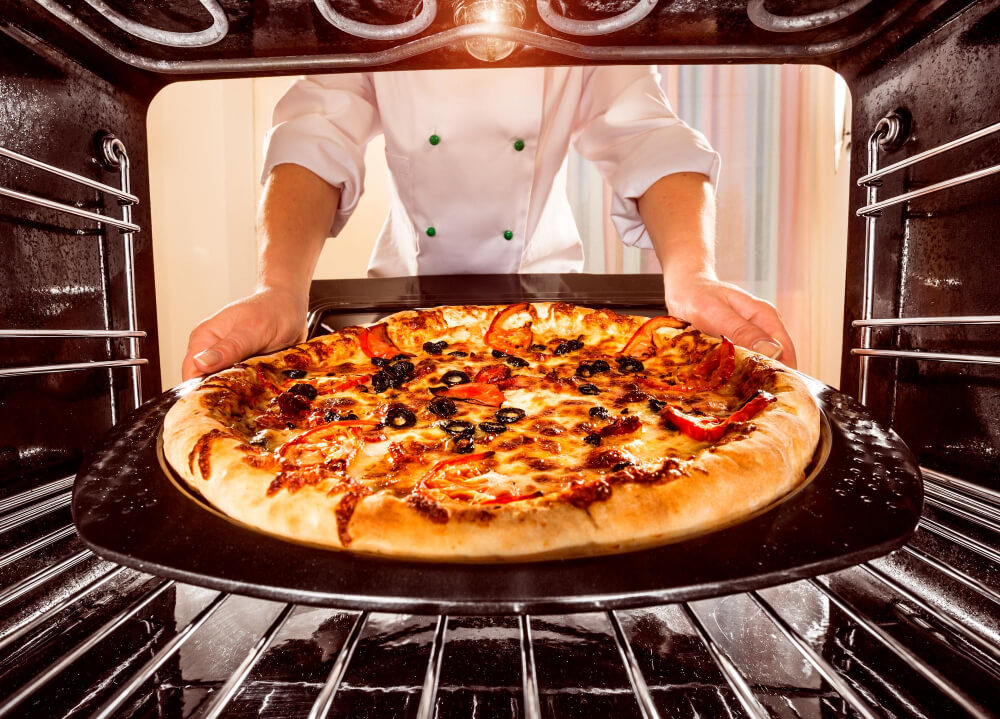
A professional pizza oven is a piece of equipment designed to bake large quantities of pizzas quickly and consistently while maintaining a high level of baking uniformity.
Unlike domestic ovens, professional models are built to withstand long operating cycles and maintain high temperatures for many consecutive hours.
A professional pizza oven must ensure thermal stability, rapid temperature recovery, and consistent baking performance even during peak production periods.
Why Does the Oven Affect the Entire Pizza Production Line?
Many people think the oven only comes into play during the final minutes of preparation.
In reality, the type of oven you choose directly affects:
-
the organization of the pizza production line;
-
the number of operators required;
-
service times;
-
productivity;
-
order management.
Learn more:
How to Organize a Pizza Line: The Method Used by Efficient Pizzerias to Work Better
The oven is the point where dough, the pizza prep counter, ingredients, and service organization all come together.
Electric, Gas, or Conveyor Pizza Oven: What Are the Differences?
This is probably the most common question asked by anyone opening a new pizzeria.
These three technologies are designed to meet different operational needs.
Professional Electric Pizza Oven
Today, it is one of the most popular solutions in contemporary pizzerias.
It allows extremely precise temperature control and enables the ceiling and deck temperatures to be adjusted independently.
Its main advantages include:
-
precision;
-
consistent baking performance;
-
ease of use;
-
flexibility.
Professional electric pizza ovens are especially appreciated in contemporary pizzerias for their precise baking control.
Professional Gas Pizza Oven
It continues to be a widely used solution, particularly in traditional pizzerias.
It delivers excellent performance together with fast temperature recovery.
Its main advantages include:
-
often competitive operating costs;
-
high production capacity;
-
durability.
Conveyor Pizza Oven
The conveyor pizza oven follows a completely different operating philosophy.
The pizza automatically passes through the baking chamber on a conveyor belt.
It is a solution widely used in:
-
dark kitchens;
-
restaurant chains;
-
high-volume production facilities;
-
delivery-focused businesses.
Conveyor ovens are mainly chosen when the primary objective is productivity and process standardization.
How to Choose a Pizza Oven Based on the Type of Pizzeria
One of the most common mistakes is evaluating an oven solely on the basis of its technical specifications.
In reality, the first selection criterion should be the pizzeria's operating model.
A traditional pizzeria, a contemporary pizzeria, and a dark kitchen face completely different operational requirements and, consequently, may require different solutions.
The best oven is not the one with the highest specifications, but the one that integrates most effectively with the pizzeria's production model.
Real Case: Traditional Table-Service Pizzeria
In traditional pizzerias, service is spread throughout the evening.
Pizzas must be served at a consistent pace, and the oven must provide reliable performance for many consecutive hours.
In this context, the most important evaluation criteria generally include:
-
the ability to maintain a stable temperature;
-
ease of operation;
-
consistent baking performance;
-
operating costs.
Many businesses continue to choose either electric or gas ovens according to their organizational requirements and the characteristics of the premises.
In traditional pizzerias, operational continuity is often more important than maximum theoretical production speed.
Real Case: Contemporary Pizzeria with High-Hydration Doughs
Contemporary pizzerias generally require more precise baking control.
High-hydration doughs and long fermentation times make accurate temperature management particularly important.
For this reason, many professionals choose professional electric ovens that allow independent adjustment of:
-
the upper heating chamber;
-
the baking deck;
-
heating element power;
-
baking programs.
This level of control makes it possible to adapt the baking process to the specific characteristics of the dough.
In contemporary pizzerias, precise thermal management is one of the main criteria when choosing an oven.
Real Case: Delivery and Dark Kitchen
Businesses primarily focused on delivery face different operational requirements.
In these environments, productivity becomes the top priority.
The goal is not simply to produce a great pizza, but also to ensure:
-
speed;
-
repeatability;
-
standardization;
-
production continuity.
For this reason, conveyor ovens are often considered a particularly attractive solution for high-volume production.
In dark kitchens, the oven is selected primarily for its ability to sustain large production volumes while delivering consistent results.
How to Choose a Professional Pizza Oven Based on Production Volume
One of the most important aspects to evaluate is the actual number of pizzas produced during service.
Many businesses purchase an oversized oven that never reaches its full potential, while others choose an undersized model that quickly becomes the main bottleneck in the production process.
For this reason, the correct approach is to assess:
-
average daily production;
-
peak production periods;
-
expected business growth;
-
the number of operators working simultaneously.
The oven should always be selected based on the maximum production level the business expects to reach over the coming years, not only on its current requirements.
Is a Larger Oven Always Better?
Not necessarily.
A larger oven requires:
-
more available space;
-
greater energy consumption;
-
higher initial investment;
-
a production volume capable of justifying its capacity.
If the oven is significantly oversized compared to the actual workload, much of its production capacity will remain unused.
The ideal solution is not the largest oven available, but the one that best matches the operational needs of the pizzeria.
How to Tell If the Oven Is Limiting Your Pizzeria's Productivity
Many operators believe the oven is slowing down production when, in reality, the bottleneck lies elsewhere.
Before replacing the oven, it is worth checking whether delays are actually caused by:
-
pizza prep counter organization;
-
dough ball management;
-
ingredient arrangement;
-
staff workflow.
Learn more:
How to Choose a Professional Pizza Prep Counter
Pizza Dough Ball Management: The Method Used by Well-Organized Pizzerias
Only after optimizing the entire production process does it make sense to evaluate whether the oven has actually become the limiting factor.
The oven is only one component of the production system and should always be evaluated together with the organization of the entire pizza line.
How Important Is Temperature Recovery?
One of the least discussed yet most important characteristics of a professional pizza oven is its ability to recover temperature quickly after each baking cycle.
During peak service, the oven door is opened continuously.
Every opening causes heat loss.
If the oven cannot restore the set temperature rapidly, baking consistency inevitably suffers.
For this reason, temperature recovery is one of the key performance indicators in professional ovens designed for intensive use.
How Much Does Energy Consumption Affect the Choice?
Operating costs are an important consideration, but they should never be the only factor in the decision-making process.
A more efficient oven may consume more energy per hour while allowing significantly higher productivity.
Conversely, a lower-powered oven may reduce energy costs but slow down service, resulting in greater overall operating expenses.
The correct approach is always to evaluate productivity in relation to total operating costs.
The Most Common Mistakes When Choosing a Professional Pizza Oven
After analyzing hundreds of pizzerias, several recurring mistakes emerge.
Choosing the Oven Before Designing the Pizza Line
Many businesses purchase the oven first and only afterwards organize the rest of the production area.
In reality, the oven should always be integrated into the overall workflow.
Focusing Only on Purchase Price
An oven is expected to remain in operation for many years.
Evaluating only the initial purchase price without considering productivity, energy consumption, and reliability often leads to an uneconomical investment over time.
Oversizing or Undersizing the Oven
An oversized oven increases investment and operating costs unnecessarily.
An undersized oven, on the other hand, quickly becomes the main production bottleneck.
Ignoring Future Business Growth
Many pizzerias experience significant growth within just a few years.
Choosing an oven based solely on current production levels may require replacing it much sooner than expected.
Practical Example: Choosing an Oven for a Pizzeria Producing 250 Pizzas per Day
Let's consider a pizzeria that regularly produces around 250 pizzas per day, with significant peaks during weekends.
In this situation, the ideal choice should take into account:
-
the actual production volume;
-
the type of dough prepared;
-
the available workspace;
-
the expected business growth over the coming years.
Many businesses with these characteristics choose professional electric ovens because they offer an excellent balance between baking control, production capacity, and operational flexibility.
However, every decision should always be based on the overall organization of the production process rather than on the oven alone.
The Oven as Part of the Entire Production System
The oven should never be considered an isolated piece of equipment.
Its performance depends directly on the efficiency of all the stages that precede it.
An efficient pizza line integrates:
-
dough preparation;
-
dough ball management;
-
the pizza prep counter;
-
the oven;
-
service.
Only when these elements work together in harmony can the pizzeria achieve maximum productivity.
Comparison Table: Electric, Gas, and Conveyor Pizza Ovens
Type of Oven |
Main Advantages |
Ideal For |
Electric |
Precise baking control, flexibility, temperature stability |
Contemporary and traditional pizzerias |
Gas |
High productivity, rapid temperature recovery, competitive operating costs |
Traditional pizzerias |
Conveyor |
Automation, standardization, continuous production |
Delivery, chains, and dark kitchens |
How to Make the Right Investment
The best oven is not necessarily the most expensive or the most technologically advanced.
It is the one that best supports the production model of the business.
Choosing a professional pizza oven means evaluating the production process as a whole, considering both current needs and future growth.
Businesses that make the best long-term investment are those that analyze the entire production workflow before selecting the equipment.
Choosing the Right Professional Pizza Oven for Your Pizzeria
A professional pizza oven is much more than a baking appliance. It is the final stage of the production process and one of the key elements influencing productivity, service quality, and workflow organization.
Choosing the right model means evaluating production volumes, the type of pizza being prepared, the business model, available space, expected growth, and the integration of the oven with the entire pizza line.
Whether you choose an electric, gas, or conveyor oven, the most important factor is ensuring that it fits seamlessly into your production system and helps the entire team work more efficiently.
A carefully selected professional pizza oven improves not only baking performance, but also the organization, profitability, and long-term competitiveness of the entire pizzeria.
SHOP NOW: