




















SHOP NOW:


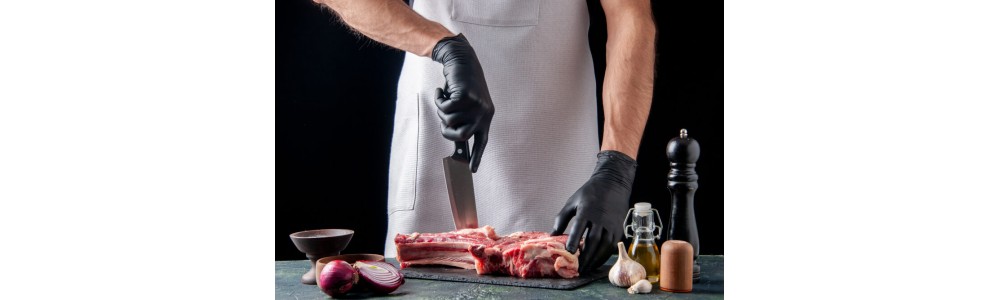
The professional bone saw is not used in the same way across all contexts.
Butcher shops and restaurants have different operational needs, and this directly affects frequency of use, type of processing, and the role of the machine within the workspace.
Understanding these differences is essential to choosing and using the bone saw in a way that is consistent with your actual work.
Is the bone saw used the same way in butcher shops and restaurants?
No, the bone saw has a different role: in butcher shops it is a central machine used continuously, while in restaurants it is used more selectively and less frequently.
Why does the role of the bone saw change depending on the context?
Each workspace has a specific organization.
The bone saw can be a core machine or a support tool, depending on the type of processing.
This difference does not depend on the machine itself, but on how it is integrated into the operational workflow.
Bone saw in butcher shops: primary processing
In butcher shops, the bone saw is often one of the main pieces of equipment.
It is used for:
- cutting carcasses and quarters
- handling large cuts
- preparing custom cuts
In this context, the bone saw directly impacts productivity and workstation organization.
Its role is further explored in the professional bone saw in the butcher shop workflow, where it is analyzed as an integral part of the workflow.
Bone saw in restaurants: targeted use
In restaurants, the bone saw has a more specific role.
It is mainly used when:
- working with bone-in cuts
- handling whole raw materials
- preparing customized portions
It is not always central, but becomes important in structured kitchens or those with in-house processing.
Frequency of use: the real difference
The main difference between butcher shops and restaurants is frequency.
- in butcher shops → continuous use
- in restaurants → occasional or targeted use
This directly affects the choice of machine and the required features.
How does the choice of bone saw change?
In butcher shops, the choice should prioritize:
- robustness
- continuous operation
- capacity to handle high volumes
In restaurants, on the other hand, more emphasis is placed on:
- compactness
- ease of use
- integration with other equipment
In both cases, it is useful to compare professional bone saws for butcher shops to identify the most suitable solution.
SHOP NOW:
Bone saw and workflow organization
Regardless of the context, the bone saw always impacts workflow organization.
It allows you to:
- speed up processing
- improve precision
- reduce operator effort
But only if it is properly integrated into the operational flow.
Connection with other equipment
The bone saw never works in isolation.
It is often connected to other processing stages.
This is particularly evident when the product moves to subsequent processes, such as those carried out with professional meat grinders for butcher shops and professional sausage stuffers in laboratory design, creating a continuous and organized workflow.
The importance of layout in different contexts
The positioning of the bone saw changes depending on the type of workspace.
In butcher shops it must be easily accessible and integrated into the workstation, while in restaurants it can be placed in a more specific area.
This aspect falls within the design of a food laboratory, where each piece of equipment is positioned according to workflow dynamics.
When does the bone saw become essential?
It becomes essential when:
- bone cutting is frequent
- volumes increase
- there is a need to improve work quality
In these cases, it is no longer an optional choice, but an operational necessity.
How to understand if the bone saw is suitable for your workspace?
To determine whether the bone saw is suitable for your workspace, it is necessary to evaluate frequency of use, type of processing, and the machine’s role within the workflow.
There is no standard way to use a bone saw
Each workspace has different needs.
The same machine can have a completely different role depending on the context.
The right bone saw is the one aligned with your work
When the bone saw is chosen based on the context, work becomes smoother, more organized and safer.
And it is precisely this alignment that determines the machine’s effectiveness.