

























SHOP NOW:


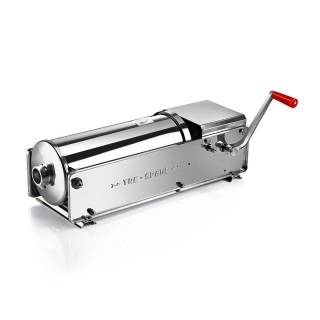


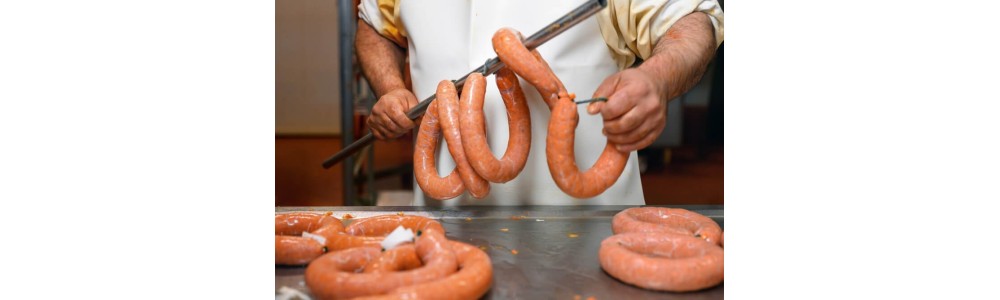
When it comes to professional sausage stuffers, one of the most common questions is whether a butcher's production area really needs one.
Many operators wonder whether a sausage stuffer is a legal requirement or simply an organisational choice linked to the type of production.
The answer is never clear-cut, because a sausage stuffer is not a formal obligation but a functional responsibility, linked to safety, hygiene and the management of the production process.
Is a sausage stuffer a legal requirement?
From a regulatory point of view, no law explicitly requires the use of a professional sausage stuffer in a butcher's production area.
The relevant rules (EU food hygiene regulations and HACCP principles) focus on the objectives to be achieved – operator safety, product hygiene and process control – not on the individual machines to be used.
The same principle guides the design of a food production area, where what matters is not the presence of a specific piece of equipment, but the ability to work safely and in compliance with the rules.
When does a sausage stuffer become necessary "in practice"?
A sausage stuffer becomes necessary when the type of production leaves no safe and efficient alternative.
If stuffing sausages by hand creates a hygiene risk, excessive strain on the operator or a loss of control over the product, using a professional sausage stuffer is no longer a choice but a technical necessity.
In these cases, the absence of the machine may be seen as a management weakness rather than simply a missing piece of equipment.
What role does HACCP play in choosing a sausage stuffer?
The HACCP system does not require the use of a specific sausage stuffer, but it does require risks to be identified and controlled.
When a sausage stuffer reduces the risk of contamination compared with manual methods, it becomes consistent with the business's food safety management plan.
The same risk-based approach applies to other production stages, such as packaging, where following procedures is central, as explained in our article on managing vacuum packing under HACCP in a food production area.
Sausage stuffers and operator safety: an indirect responsibility
Employers are required to provide equipment suitable for reducing risks during processing.
If stuffing by hand exposes the operator to excessive effort or repetitive movements, failing to use a sausage stuffer may become an indirect liability in the event of an accident at work.
The same applies to other key equipment in a production area, as explained in our article on professional equipment in the design of a food production area.
In which production areas is a sausage stuffer strongly recommended?
A sausage stuffer is strongly recommended in any production area that makes sausages and other cased products on an ongoing basis, even in small volumes.
Artisan butcher's shops, delicatessens with in-house production and contract processing facilities all find the sausage stuffer an essential tool for ensuring consistency, hygiene and good work organisation.
In these settings, the sausage stuffer becomes an integral part of the processing line, together with meat mincers and meat mixers.
Can you work compliantly without a sausage stuffer?
Yes, but only in specific and limited cases.
Occasional production, small volumes or processes that can be shown to be safe may not require a professional sausage stuffer.
However, as soon as production becomes structured or repetitive, the lack of a machine is a weak point in terms of both organisation and hygiene.
When does it make sense to move on to choosing a sausage stuffer?
Only once you have established whether a sausage stuffer is necessary from an operational and management point of view does it make sense to look at the models available.
At that point it becomes useful to compare the professional sausage stuffers best suited to your production area, taking into account space, production volumes and the type of processing.
The sausage stuffer as a functional requirement, not a legal one
Talking about an obligation in the strict sense is too narrow.
In most cases, a professional sausage stuffer becomes a functional requirement, arising from the need to work safely, maintain hygiene and ensure continuity of production.
Understanding this difference allows you to make more informed choices and to design production areas that stand the test of time.
SHOP NOW:
The need for a sausage stuffer comes from responsibility, not regulation
A sausage stuffer is almost never imposed by law, but it is often demanded by the reality of day-to-day work.
Assessing it properly means preventing organisational and hygiene problems, rather than having to deal with them after the fact.
This article looks at why a sausage stuffer is needed; the next ones will look at how, analysing operational differences, capacity and day-to-day management.