

























SHOP NOW:
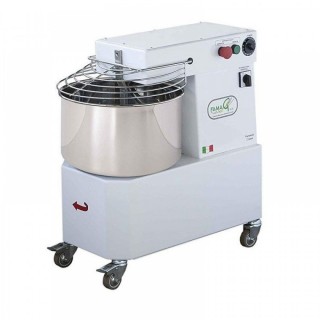
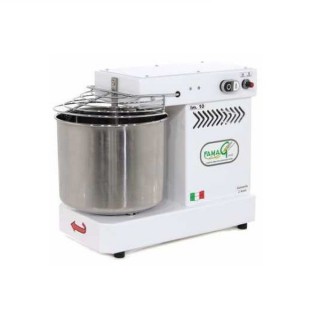
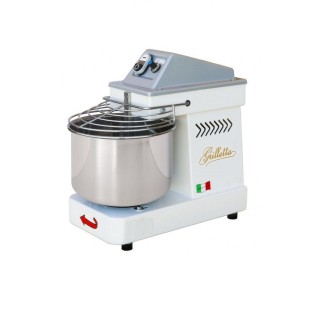
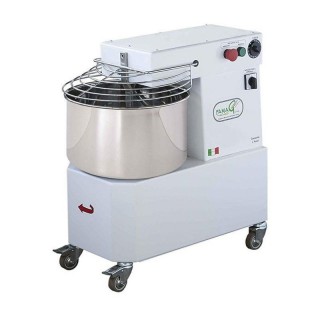
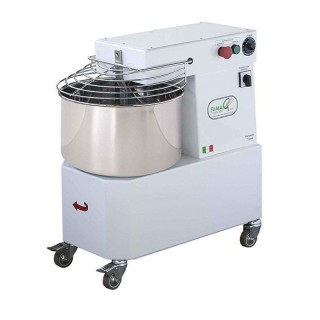
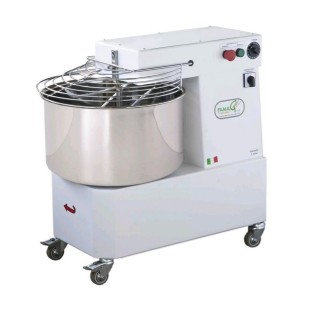


A 5 kg dough mixer: your right hand in the kitchen
Unlike in the past, today we can prepare almost anything in the kitchen with dedicated machines and accessories that make cooking easier. This also applies to dough for pasta, bread, pizza, savoury pastries, biscuits and cakes: where once everything was kneaded by hand, with dedication and a fair amount of strength, today we have machines that let us prepare doughs, even complex ones, in a much shorter or at least reasonable time, with excellent results that satisfy even the most discerning palates.
Dough mixers are among these fantastic machines: many people, especially home cooks who love experimenting in the kitchen, can no longer do without them. So let us look at what they are and uncover the secrets that can be useful to us too.
There is, however, one question that comes before all the others, and almost nobody asks it in the right order: not which mixer, but how big. The spiral mixers in our catalogue range from 5 to 50 kg bowl capacity, and between the smallest and the largest it is not just the price that changes: so do the footprint, the power supply and, less obviously, how little dough you can mix. You will find them all under professional dough mixers; below is the full range, with the rated specifications.
SHOP NOW:
Professional spiral mixer vs professional planetary mixer
Two similar machines designed for different jobs.
The fixed-head professional 5 kg spiral mixer is mainly used for stiff doughs: fresh pasta, bread, pizza and denser cake and pastry doughs that are harder to work. In a spiral mixer, the spiral-shaped hook aerates the dough and develops the gluten, giving a lighter, more digestible dough.
On spiral mixers that also have a second speed, you can work soft doughs too, such as high-hydration dough for pizza by the slice.
This type of mixer is clearly best suited to professional production, where large quantities have to be made in a short time, in pizzerias, bakeries and pastry shops, because it is fast, economical and versatile, but it also works well in a home kitchen.
A professional planetary mixer, on the other hand, is designed for soft mixtures, such as cake batters and creams like crème pâtissière or Chantilly cream. It is ideal for pastry work.
How big should the bowl be? The real range from 5 to 50 kg
The stated capacity is flour plus water, not flour. This is the first misunderstanding to clear up: a 5 kg machine does not mix five kilos of flour, it mixes five kilos of finished dough, which at 60% hydration means just over three kilos of flour. Anyone who calculates on flour alone ends up buying a machine a third too small.
This is the Famag spiral mixer range in our catalogue, with rated data taken from the product sheets and prices as displayed on 1 October 2026, including Italian VAT:
| Model | Max dough | Min dough | Hourly output | Power supply | Footprint | Weight | Price |
|---|---|---|---|---|---|---|---|
| Famag IM 5 Grilletta | 5 kg | 1 kg | 18 kg/h | 230 V — 370 W | 25 × 45 · h 35 cm | 27 kg | €645.00 |
| Famag IM 8/230 | 8 kg | 1 kg | 24 kg/h | 230 V — 0.5 hp | 52 × 28 · h 43 cm | 30 kg | €686.01 |
| Famag IM 10/230 | 10 kg | 1 kg | 30 kg/h | 230 V — 0.75 hp | 53 × 43 · h 30 cm | 35 kg | €747.01 |
| Famag IM 15/230 | 15 kg | 1 kg | 36 kg/h | 230 V — 750 W | 64 × 34 · h 70 cm | 60 kg | €1,080.01 |
| Famag 20 kg single-phase | 20 kg | 1 kg | 36 kg/h | 220 V — 750 W | 66 × 38 · h 70 cm | 65 kg | €1,250.00 |
| Famag IM 30 | 30 kg | 1.5 kg | 90 kg/h | 230 V — 1,100 W | 74 × 42 · h 74 cm | 75 kg | €1,757.00 |
| Famag IM 40/230 | 40 kg | 1.5 kg | 120 kg/h | 230 V — 1,100 W | 77 × 47 · h 74 cm | 80 kg | €1,888.00 |
| Famag IM 50/400 | 50 kg | 2 kg | 150 kg/h | 400 V three-phase — 2,200 W | 85 × 53 · h 87 cm | 120 kg | €2,048.00 |
Rated data and prices taken from the Cornerchef product sheets on 1 October 2026, including Italian VAT. Prices change: the table is meant to show how the sizes compare, not to serve as a price list.
Why a bigger bowl does not always mean more output
The hourly output column reveals something the price alone does not: output does not grow with bowl size. The 15 kg and the 20 kg models declare exactly the same hourly output, 36 kg/h, and the second costs €170 more. Same power, 750 W, five more kilos of bowl and not a single extra kilo per hour.
The real jump comes between 20 and 30 kg, and it is a big one: the 30 kg goes from 36 to 90 kg/h, two and a half times as much, because the power also rises, from 750 to 1,100 W. Below that threshold you are buying capacity; above it you are buying speed.
The practical consequence is simple: if time is your problem, moving up one size will not solve it; you need to move up a class. If you mix 25 kg a day in two batches, you do not need a 20 kg machine: you need a 30 kg one, or you keep the 15 kg and organise your dough production differently.
Minimum capacity: the figure nobody looks at
Every machine also has a minimum, and it is the constraint that spoils the most purchases. The spiral needs enough mass to grip: below that threshold it spins without working the dough, warming it up instead. From 5 to 20 kg the minimum is 1 kg; on the 30 and 40 kg models it rises to 1.5 kg; on the 50 kg it reaches 2 kg.
This means a 50 kg mixer cannot mix one kilo of flour. Businesses with mixed production, such as a pizzeria that also bakes bread or a workshop that alternates different doughs in small batches, may find that the big machine bought "to be on the safe side" cannot handle the small batches, and this is a problem you only discover afterwards. In those cases, two medium-sized machines work better than one large one.
Countertop or floor-standing: the jump comes between 10 and 15 kg
The table shows a break that has nothing to do with capacity but with space, and it affects your kitchen layout more than the price does. Up to 10 kg you stay with a countertop machine: the Famag IM 10 is 30 centimetres high and weighs 35 kg. From 15 kg upwards you move to a floor-standing machine: 70 centimetres high and 60 kg in weight, rising to 120 kg for the 50 kg model.
One counter-intuitive detail of the range is worth noting: the 10 kg model is lower than the 8 kg, 30 centimetres against 43, because it has a different body. If you need to fit under a wall cabinet, the larger machine is also the one that fits.
The real consequence is that above 10 kg a mixer stops being a piece of equipment and becomes a piece of furniture. Sixty kilos on castors are not moved at the end of service to clean the worktop underneath: they take up a spot, and they take it up for good. In an already cramped kitchen, that is the difference between a machine you use and one that gets in the way.
When you need three-phase power, and when to stop before it
Up to 40 kg the whole range is single-phase, 220–230 V: it plugs into a standard heavy-duty power socket. The 50 kg model is three-phase only, 400 V, with a 2,200 W power draw.
If your premises do not have a three-phase supply, the top of the range for you is the 40 kg single-phase model, which still declares 120 kg/h, 80% of the 50 kg. Before falling for the big machine, it is worth checking your electrical panel: bringing in three-phase power where there is none costs more than the difference between the two machines, and it is not a job done in a morning.
On the other hand, from 15 kg upwards a timer comes as standard. Smaller models do not have one, and on a machine that mixes batch after batch its absence is felt more than you might think: without a timer the mixing time depends on the operator, and with two different people on two different shifts it is no longer the same dough.
Ten speeds, removable bowl, high hydration: which options pay off
Within the same size, the configuration changes the price more than moving up a size does. This is the full range on a 5 kg machine, where the options are easiest to compare:
| Configuration, 5 kg | Price | Difference from base model |
|---|---|---|
| Famag IM 5 Grilletta single-phase, base | €645.00 | — |
| + 10 speeds | €794.00 | + €149.00 |
| + 10 speeds, high hydration | €874.00 | + €229.00 |
| + 10 speeds, removable bowl | €986.00 | + €341.00 |
| + 10 speeds, high hydration, removable bowl | €1,066.00 | + €421.00 |
A fully optioned 5 kg mixer costs €1,066. A base 15 kg costs €1,080. A difference of fourteen euros for three times the bowl and twice the hourly output. This is the comparison to make before signing, and almost nobody makes it because people look at the configurations of one size at a time.
What each option really does
- Ten speeds let you start slowly and finish fast. On direct, low-hydration doughs the difference is modest; on doughs that need to develop a strong gluten structure without overheating, it is what stops you from overworking the gluten.
- The removable bowl is, according to the catalogue, a dishwasher-safe bowl. It is not just a convenience: in a workshop that alternates doughs with and without allergens, or sweet and savoury, it is how the bowl actually gets washed properly, and under HACCP / EU food safety rules it is the difference between a written procedure and one you can actually carry out.
- The high-hydration configuration concerns the geometry of the spiral and the dough-breaker bar, and is designed for doughs above 75–80% water. For why hydration changes the machine and not just the recipe, see our guide to choosing a professional dough mixer, which also compares spiral, fork, diving-arm and planetary mixers.
When you do not need the options
If you make only one type of dough at normal hydration, the base machine does the same job. In a pizzeria working a single recipe at 60% hydration, the ten speeds will stay on two settings for the whole life of the machine, and a removable bowl is for those who change dough, not those who repeat it. Before spending €421 on options for a 5 kg mixer, ask yourself whether that money, spent on a bigger size, would solve a bigger problem.
The opposite is also true, and this is when the option is the right purchase: if you are short of space and cannot move up a size, buying features instead of capacity is the right call, as it is the only way to get more out of a machine that cannot grow.
For the rest of the range and other departments: professional dough mixers, bread mixers, pizza dough mixers and planetary mixers.
The best dough mixers at the best prices on our website
The 5 kg 10-speed spiral mixer FAMAG IM5 GRILLETTA is a machine for making many types of dough, particularly suited to soft doughs such as pan pizza, pinsa romana, piadina, gluten-free doughs, small and large leavened products, and even biscuits.
A top-quality product, made in Italy from the best materials available on the market. Thanks to its carefully engineered, reliable mechanics, the machine is quiet, energy-efficient and requires no maintenance. With 10 selectable speeds (higher speeds help to pick up the flour and dry the dough, making the work faster), you can also make professional-quality doughs. Thanks to careful choice of materials and components, this professional 5 kg spiral mixer combines a compact size with low noise, long service life and low energy consumption. The professional 5 kg dough mixer is the smallest countertop spiral mixer on the market. Despite its very compact dimensions, it packs power, innovation and outstanding results. Designed and built like the large dough mixers, the IM5 is suitable for both home and professional use.
It has an automatic safety lock that stops the machine if the stainless steel guard is lifted during use, and lets you easily mix up to 5 kg of dough without the slightest effort.
- Heavy-gauge steel frame
- Chain drive
- Non-toxic, food-safe epoxy powder coating
- Stainless steel bowl, spiral and dough-breaker bar
- Maximum dough capacity: 5 kg (flour + water)
- Minimum dough capacity: 1 kg (flour + water)
- Flour: 3 kg – Water: 2 litres
Frequently asked questions about spiral mixers
Start from the finished dough, not the flour: the stated capacity is flour plus water, so a 5 kg machine at 60% hydration handles just over three kilos of flour. Then look at the hourly output, which does not grow with bowl size: the 15 and 20 kg models both declare 36 kg/h, while the 30 kg rises to 90 kg/h. If time is the problem, moving up one size is not enough; you need to move up a class.
From 5 to 20 kg the minimum is 1 kg of dough; on the 30 and 40 kg models it rises to 1.5 kg, and on the 50 kg it reaches 2 kg. Below that threshold the spiral cannot find enough mass to grip: it spins and warms the dough instead of working it. That is why a large machine bought "to be on the safe side" can turn out to be unusable for small batches.
The jump comes between 10 and 15 kg. Up to 10 kg you stay with a countertop machine: the Famag IM 10 is 30 centimetres high and weighs 35 kg. From 15 kg upwards you move to a floor-standing machine, 70 centimetres high and weighing 60 kg, rising to 120 kg for the 50 kg model. Curiously, the 10 kg is lower than the 8 kg, 30 centimetres against 43: if you need to fit under a wall cabinet, the larger machine is also the one that fits.
Not up to 40 kg: the whole range below that size is single-phase, 220–230 V, and plugs into a standard heavy-duty power socket. Only the 50 kg is three-phase, 400 V, with a 2,200 W power draw. Without a three-phase supply, the top of the range is the 40 kg single-phase model, which still declares 120 kg/h against 150 kg/h for the 50 kg.
It depends on how many different doughs you make. The removable bowl is dishwasher safe and is useful if you alternate production, sweet and savoury, with and without allergens, because it is how the bowl actually gets washed properly. Ten speeds let you start slowly and finish fast on doughs that need to develop gluten without overheating. In a pizzeria that always makes the same recipe at normal hydration, the base machine does the same job.
The Famag spiral range goes from €645.00 for the base 5 kg to €2,048.00 for the three-phase 50 kg, according to Cornerchef catalogue prices in October 2026, including Italian VAT. The comparison worth making is another one: a fully optioned 5 kg costs €1,066, while a base 15 kg costs €1,080. Fourteen euros' difference for three times the bowl and twice the hourly output.