

























SHOP NOW:


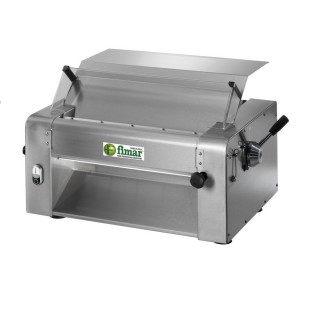


A pasta sheeter, also known as a pasta machine or pasta roller, is a tool made up of two cylinders turning in opposite directions: the dough passes between them and is flattened, so you can make many different types of pasta. That is why it is so useful in the kitchen.
The advantages of having a pasta machine at home
Pasta dishes are among the most popular dishes in the world, especially in Italy, the home of pasta. They are delicious, lend themselves to a huge variety of recipes and are generally easy to prepare, even for people with little cooking experience. You can find pasta dishes everywhere, from the simplest classics to the most refined creations, both in restaurants and at home. And to perfect the flavour of your pasta, nothing beats making it yourself with a good pasta machine: it lets you cook homemade pasta in a wide range of shapes and flavours (you can add your favourite ingredients to the dough to give it flavours and aromas you will rarely find in shop-bought pasta).
Before going into detail, a note on names: pasta sheeter, pasta machine, pasta roller and dough sheeter (in Italian sfogliatrice, sfogliapasta, tirapasta and laminatoio) all describe the same tool: two rollers that press the dough down to the thickness you want. Only the speaker's habit changes. In our catalogue you will find them all under pasta sheeters, from hand-cranked tabletop machines to professional machines with 52 cm rollers.
SHOP NOW:
How to choose the best pasta sheeter
A pasta sheeter is the essential tool for getting the best possible results, but it can also be used for other types of dough: pizza, laminated focaccia dough and much more (just let your creativity run free!).
So when deciding between the manual and electric models on the market, start by considering:
- what you will use it for;
- how much you want to spend;
- its footprint and weight, since it has to fit the size of your kitchen;
- whether the thickness is adjustable, so you can make every type of pasta sheet.
Manual or electric pasta sheeter?
Both manual and electric pasta sheeters are available: which is right for you?
These machines always have a metal body, ideally in stainless steel, which comes into contact with food without affecting it. A clamp or screw clamp fixes the machine to the worktop so that it stays firmly in place while you work. Let's compare them:
- Manual machines have the advantage of being cheaper than electric models. They help make flattening and cutting pasta more precise and easier. However, using a manual sheeter takes some effort: it is operated by turning a hand crank, which is certainly not very comfortable when working with large quantities of pasta. You have to turn the crank with your own strength to push the dough through the rollers and roll it out to the thickness you want.
- Electric machines take less effort because they are much more practical and efficient than manual models: the rollers are driven by an electric motor. Just select the thickness you want, flick a switch and feed the dough through. This way you can process a large quantity of pasta with minimal effort in minimal time. They are, however, more expensive.
Electric pasta machine: what really changes compared with a manual one
The motor does not change the pasta sheet; it changes how many sheets you can make in a row. On the same machine, the rollers are the same and so is the thickness you get: what disappears is the arm turning the crank while your other hand guides the dough. You do not notice the difference on the first sheet, but you notice it a great deal on the tenth.
On a home machine, the choice shows more in the specifications than in the result. The manual Marcato 150 Roller adjusts the roller gap across 9 settings, from 2.5 to 0.3 mm, with a numbered indicator; the Hendi electric pasta machine has 7 settings, from 0.2 to 2.5 mm, and comes with three interchangeable rollers: sheet, 6.25 mm tagliatelle and 2 mm fettuccine. The thickness range is the same. What changes is effort and consistency: by hand, the speed at which you turn the crank determines how much the dough is stretched, and by the tenth sheet your speed is no longer the same.
You can add the motor later
This is the point hardly anyone mentions, and it changes the decision. On machines in the Atlas range, the motor is an accessory you can add later: the Pastadrive 220V motor costs €90.00 and fits the machine you already own. Buying the Atlas Motor 150 with the motor already fitted costs €145.00, compared with €75.01 for the manual Atlas 180.
So "manual or electric" is not a decision you have to make now and for ever, as long as you stay within that family of machines: start with the crank and add the motor when frequency of use justifies it. It is worth bearing in mind before spending twice as much because of a doubt.
When you do not need a motor
If you make pasta once a fortnight, a motor is money spent on a problem you do not have: on a 150 mm sheet, cranking takes around twenty seconds per portion, and you spend that time next to the machine guiding the dough anyway. The motor starts to pay for itself when making pasta becomes a weekly habit, not before.
There is, however, one case in which a motor is almost essential: when you work with stiff doughs, such as low-hydration egg pasta or pizza dough. By hand, the resistance of the rollers on the first pass is considerable, and the sheet comes out uneven exactly where the crank slowed down.
How wide should the pasta sheet be: 15, 17 or 42 centimetres?
This is the specification that matters more than any other, and the one people look at least. The width of the rollers sets the maximum width of the sheet, and everything else follows from it: how many lasagne sheets you make in one pass, whether you can roll out a whole pizza base, how long it takes you to get through a kilo of dough.
This is the real range, with prices shown in our catalogue on 1 October 2026, including VAT:
| Machine | Type | Sheet width | Weight | Price |
|---|---|---|---|---|
| Tacapasta pasta drying rack | accessory | — | — | €35.00 |
| Marcato 150 Roller | manual | 150 mm | tabletop | €44.01 |
| Pasta roller 180 | manual | 180 mm | tabletop | €50.00 |
| Marcato Ampia 150 Classic | manual | 150 mm | tabletop | €60.00 |
| Marcato Atlas 180 | manual | 180 mm | tabletop | €75.01 |
| Marcato Regina RE17 | manual with cutter | — | tabletop | €79.00 |
| Pastadrive 220V motor | motor kit for Atlas | — | — | €90.00 |
| Marcato Atlas Motor 150 | electric, domestic | 150 mm | tabletop | €145.00 |
| Hendi H-224847 | electric, countertop | 170 mm | countertop | €225.00 |
| Lilly with bronze dies | mixer-extruder | does not sheet | 16 kg | €1,096.78 |
| Fimar SI/420 three-phase | professional | 420 mm | 61 kg | €1,850.00 |
| Fimar SI/420 single-phase | professional | 420 mm | 61 kg | €1,870.00 |
| Fimar SI/520 single-phase | professional | 520 mm | 70 kg | €1,967.01 |
| Fimar SI/520 three-phase | professional | 520 mm | 70 kg | €2,190.00 |
Prices shown on Cornerchef product pages on 1 October 2026, including VAT. Prices change: the table is meant to show orders of magnitude and the gap between price bands, not to serve as a price list.
The table says one thing, and it needs saying clearly: there is no middle ground. Between €225.00 for the widest countertop electric machine and €1,850.00 for the smallest professional one, there is nothing. This is not a gap in our catalogue; it is how the market works: above a 17 cm sheet width, machines stop being household appliances and become commercial equipment, with a stainless steel frame, a 0.37 kW motor and a weight of sixty kilos. Anyone looking for "a professional machine, but small" is looking for a machine that does not exist, and ends up buying twice.
Why width matters more than thickness
Every machine, from €44 upwards, lets you adjust the thickness, and the ranges are similar. Width is different: it is fixed, it is mechanical and there is no way around it. With 150 mm rollers you make a lasagne sheet from two strips side by side; with 420 mm rollers you make it in one piece. For pizza the problem is even clearer: as explained further down, a pizza base needs to be rolled out to around 30 centimetres, and a 15 cm home machine cannot get there in one pass. You have to feed the dough through twice and join it, and the seam shows once it is baked.
When a home pasta sheeter is no longer enough
The dividing line is not the volume of pasta, as is often said. It is washing. A home machine is made of chrome-plated steel with anodised aluminium alloy rollers, and must be cleaned dry, with a brush and no water: that is why the manual repeats it on every page. In a professional kitchen, where everything is washed with detergent at the end of service, those rollers lose their finish and wear out within a few months. A Fimar SI/420 pasta sheeter is made entirely of AISI 304 stainless steel, rollers included, polished to a mirror finish: it is built to be washed every day.
The other three signs that it is time to move up a category:
- The sheet is not wide enough. If you join two passes to make a lasagne sheet or a pizza base, you are already working badly and the product shows it.
- The roller gap does not open as far as you need. Fimar professional machines open from 0 to 10 mm, so they handle egg pasta, pizza and piadina (Italian flatbread) doughs. A home machine stops at 2.5 mm and cannot do pizza.
- You need to cut, not just roll. The SI/520 takes 2, 4, 6 and 12 mm cutting attachments, giving you tagliolini, tagliatelle, fettuccine and pappardelle from the same machine.
When a professional machine is a mistake
Below five kilos of pasta a day, a professional machine is oversized, and not because of the price. An SI/420 weighs 61 kg and takes up 68 × 48 centimetres of worktop: it is not a machine you take out and put away, it is a machine that occupies a permanent spot and occupies it all the time. In an already cramped kitchen, sixty kilos of idle equipment are worth less than ten minutes of cranking a day.
And one clarification that prevents a common buying mistake: the Lilly machine with bronze dies is not a pasta sheeter. It mixes and extrudes, producing 2.5–5 kg of extruded pasta an hour, one shape at a time, but it does not roll sheets. If you want thin tagliatelle and lasagne, you do not buy an extruder; if you want rigatoni, you do not buy a sheeter. They are two different jobs that happen to sit in the same department.
If yours is a professional kitchen, the model comparison and the reasons why restaurant kitchens choose stainless steel are covered in detail in our article on Fimar pasta sheeters in restaurants, while the full range is in pasta sheeters. If what you need is to produce extruded pasta shapes, the right department is fresh pasta machines; to roll out pizza and piadina bases, go for pizza dough sheeters. And since every pasta sheet starts from a dough, it is also worth reading how to choose a professional dough mixer: a good sheeter cannot rescue a badly worked dough.
Size, weight and materials
If you have a small kitchen, a standard pasta sheeter will not take up too much space or weigh too much. Professional and extrusion machines, which are bulkier and heavier, take up much more room and need a space dedicated entirely to them.
Pay attention to the construction material, because it ensures a long life for the machine even with constant use. Choose stainless steel, which is safe in contact with food, and keep plastic to a minimum, limited to seals, because it does not stand up well to frequent washing.
Thickness adjustment and roller width
The gap between the two rollers determines the thickness of the dough, while the width of the rollers determines the width of the sheet once the dough has been processed for its intended use (tagliatelle, macaroni, cannelloni, ravioli, penne, spaghetti, lasagne, pizza, pastry and so on).
Choose a model that lets you adjust the thickness according to the type of dough you want. On a pasta sheeter, the numbered settings for the roller gap are inversely proportional to the thickness of the dough: the higher the setting, the thinner the pasta once it has been through the rollers.
Choose a pasta sheeter with rollers long enough to give you the sheet width you need. The wider the roller, the more dough you can process. A wide roller is also better suited to making pizza dough: this famous Italian dish requires a flattened dough about 30 centimetres across. A wide pasta sheeter will be not only more efficient but also more versatile.
Ease of use and accessories
Electric pasta machines offer greater ease and speed, while manual ones give you more control over the dough. Either way, all recent models are designed to be easy to use. Pay attention to maintenance and how easy the machine is to clean (models that are easy to take apart are preferable).
Also consider the accessories available, which can make certain types of pasta easier to produce, and an instruction manual, which is especially useful when the model has a motor.
Pasta sheeters in our catalogue
In our online shop you will find the best pasta sheeters from leading brands, in stainless steel, along with many other accessories for fresh pasta and for your love of cooking. Visit our website and buy everything you need.
Frequently asked questions about pasta sheeters
The sheet you get is the same: the rollers and thickness adjustment are equivalent. What changes is consistency over long sessions, because by hand the speed at which you turn the crank determines how much the dough is stretched, and after ten sheets it is no longer the same. On machines in the Atlas range, the motor can also be added later, with the €90.00 Pastadrive.
For homemade egg pasta, 150 mm is enough, which is the size of tabletop machines. For whole lasagne sheets and pizza bases you need at least 300 mm, and that means moving up to professional machines, which start at 420 mm. Below that width, the dough has to be fed through twice and joined, and the seam shows once it is cooked.
Yes, on machines in the Atlas range. The Pastadrive 220V motor fits directly onto the machine you already own and costs €90.00. That is why, within that family, the choice between manual and electric is not final: you start with the crank and add the motor when frequency of use justifies it.
The dividing line is not the volume of pasta but washing. Home machines have anodised aluminium alloy rollers and must be cleaned dry; in a kitchen where everything is washed at the end of service, they are ruined within a few months. Professional machines are made entirely of AISI 304 stainless steel, rollers included, and are built to be washed every day. The other signs are a sheet that is not wide enough and a roller gap that does not open far enough for pizza dough.
Yes. Pasta sheeter, pasta roller, pasta machine and dough sheeter all describe the same machine: two rollers that press the dough down to the thickness you want. Only the speaker's habit changes, and partly the context: in Italy, "sfogliapasta" is heard more often at home, while "tirapasta" and "laminatoio" are more common in pastry kitchens and workshops.
Manual tabletop machines cost between €44 and €79, domestic electric machines between €145 and €225, and professional stainless steel machines with 420 and 520 mm rollers between €1,850 and €2,190 (Cornerchef catalogue prices in October 2026, including VAT). Between €225 for the largest domestic machine and €1,850 for the smallest professional one there is no intermediate price band: anyone looking for a small professional machine is looking for a machine that does not exist.