
























SHOP NOW:



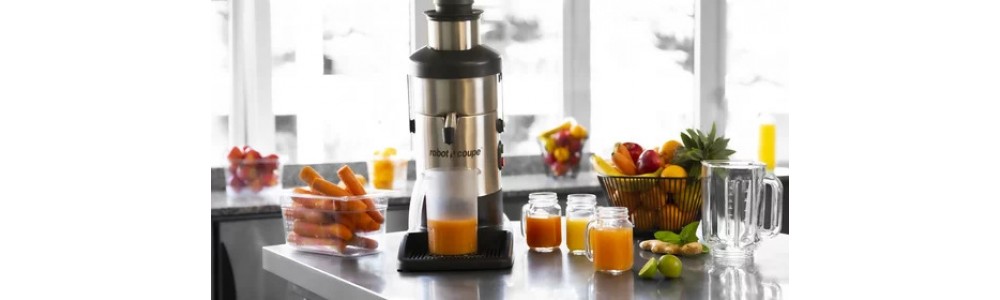
In recent years, demand for fresh fruit and vegetable juices has grown enormously. From bars and restaurants to hotels with buffets and staff canteens, more and more businesses offer natural juices as a healthy alternative to industrially produced drinks. But to meet this demand it is essential to choose the right equipment: is a professional juice centrifuge or a slow juicer the better choice?
These two machines do a similar job but have different characteristics and give different results. The choice depends on the type of business, the volume of work and the quality you expect from the final product. In this article we look at the differences between a centrifugal juicer and a slow juicer, then analyse in detail the key factors for choosing the right model and the Robot Coupe and Easyline juice extractors, two of the most reliable brands in the sector.
SHOP NOW:
How to choose between a professional juice centrifuge and a slow juicer
Before opting for a centrifuge or a slow juicer, it is important to consider a few key factors:
- Motor power and speed: a professional juice centrifuge needs at least 700 W of power and a high speed to separate the juice from the pulp quickly. Slow juicers, on the other hand, run at low speed (40–80 rpm) to preserve vitamins and nutrients as fully as possible.
- Capacity and continuous operation: if your business produces high volumes, you need a model with a high hourly output and a continuous pulp ejection system to avoid frequent interruptions.
- Ease of cleaning and maintenance: some professional models have baskets that can be removed without tools and self-cleaning systems, cutting maintenance time.
- Materials and durability: the best centrifuges and juicers have stainless steel components, which last longer and are easier to clean.
- Noise: if customers are present while you work, a quiet model is preferable.
- Efficiency and minimal waste: slow juicers extract more liquid from the same ingredients, producing less waste than centrifuges.
- Budget and investment: a professional juice centrifuge generally costs less than a slow juicer, but it is essential to weigh up cost, lifespan and the quality of the final product.
What is the difference between a juice centrifuge and a slow juicer?
A centrifuge shreds the produce and separates the juice at 6,000–12,000 rpm, while a slow juicer cold-presses it at 40–80 rpm. Every other difference follows from this difference in speed: yield, how long the juice keeps, service time and which fruit or vegetables are worth processing.
The heat and air a centrifuge incorporates start oxidation the moment the juice comes out. A slow juicer, working cold with an auger, incorporates far less.
| Professional juice centrifuge | Professional slow juicer | |
|---|---|---|
| How it works | Blades and rotating filter, centrifugal force | Auger that crushes and cold-presses |
| Speed | 6,000–12,000 rpm | 40–80 rpm |
| Time per juice | A few seconds | 1–2 minutes, plus preparation |
| Yield from hard fruit | Good | Good, slightly higher |
| Yield from leaves and herbs | Low: spinach, celery and kale yield little | High: this is where the difference shows most |
| How long the juice keeps | Serve immediately: it separates within 15–20 minutes | 24–48 hours in the fridge, in a full, sealed container |
| Noise | High, audible in the dining area | Low |
| Cleaning | Quick, but the filter must be brushed at the end of every service | Longer: auger, filter and seals |
| Best for | Bars, breakfasts, self-service: lots of juices in a short time | Green juices, detox juices, bottled juice sales, advance preparation |
When neither is the right choice. If your main product is freshly squeezed orange juice, you need neither: you need a citrus juicer. Centrifuges and slow juicers handle citrus fruit poorly and slowly, and the peel spoils the taste.
What happens if you choose wrong. A centrifuge used for a green juice menu yields about half as much from leafy greens: you pay twice for the raw ingredients for the same glass, and your margin disappears within the first month. Conversely, a slow juicer in a bar with service peaks becomes the bottleneck: if you have to serve thirty juices in twenty minutes, the queue forms at the machine.
Professional juice centrifuge: speed and efficiency for high volumes
A professional juice centrifuge is the ideal choice if you need to prepare juices in just a few seconds, with extremely fast processing. It works with a grating disc that spins at high speed, breaking down the fruit and vegetables and separating the juice from the pulp by centrifugal force. This produces light, clear drinks with no suspended pulp.
The main advantages of a professional juice centrifuge are:
- Speed of preparation: juices are ready in moments, ideal for bars with a high flow of customers.
- No pre-cutting needed: many professional centrifuges have wide feed chutes that take whole fruit and vegetables.
- Easy cleaning: some models have self-cleaning systems that reduce maintenance time.
However, a centrifuge also has some disadvantages. The high-speed process generates heat, which can slightly alter the vitamin and antioxidant content. The juice is also less dense and keeps for less time than a cold-pressed juice.
Professional slow juicer: superior quality and higher yield
A slow juicer uses a slow squeezing method known as cold pressing (which is why these machines are also called cold-press juicers): an auger turns slowly (usually between 40 and 80 rpm), crushing and pressing the ingredients to extract the juice. This process preserves the nutritional properties of the fruit and vegetables, producing a juice that is richer in vitamins, minerals and antioxidants and keeps longer than one made with a centrifuge.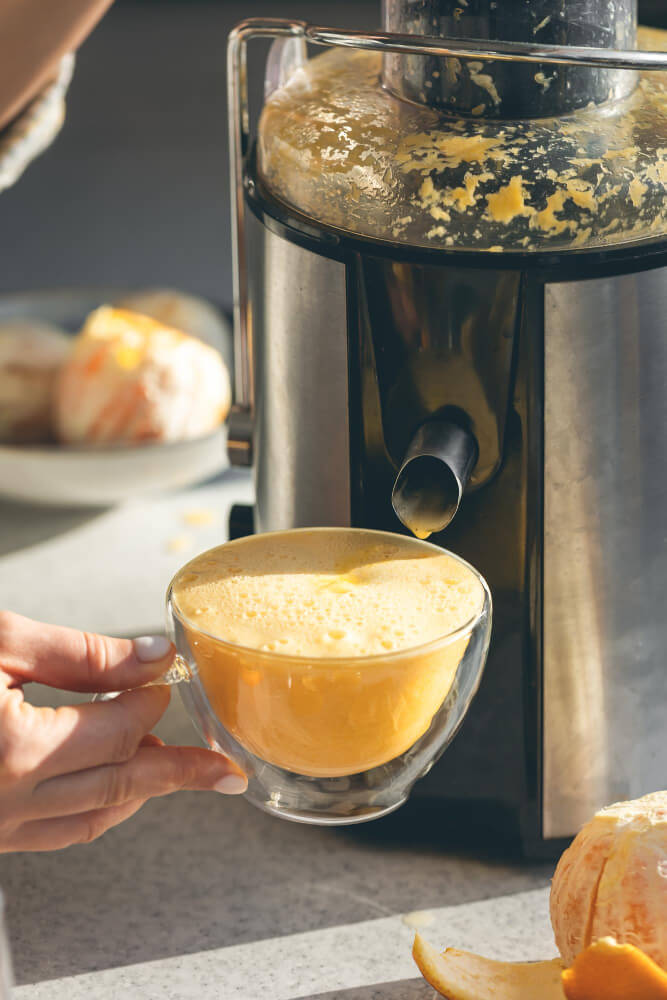
The main advantages of a professional slow juicer are:
- Better nutritional quality: the juice retains more nutrients than juice made with a centrifuge.
- Higher yield: slow juicers extract more juice from the same quantity of fruit and vegetables, reducing waste.
- Longer keeping: juice made with a slow juicer can be kept for up to 24 hours without oxidising quickly.
- Versatility: some slow juicers can also process soft ingredients to make sauces and purées.
The main disadvantage is that the process is slower, making it less suitable for businesses with high customer volumes where speed of service is a priority.
Robot Coupe and Easyline juice extractors: which model to choose?
If you have decided on a professional juice extractor, Robot Coupe offers a range of models to suit different needs. Alternatively, smaller businesses looking for an efficient juicer that is more compact and more affordable can choose an Easyline slow juicer. Let's look at the features of the brands' main juice extractors and the situations each one suits best.
Robot Coupe J 80 – Ideal for bars and restaurants
The Robot Coupe J80 is perfect for businesses that want to add fresh juices to their menu without sacrificing speed. Thanks to its automatic feed hopper, there is no need to use a pusher, allowing continuous, effortless preparation. The 700 W motor is powerful and quiet, suitable for front-of-house use. And thanks to the stainless steel basket, which can be removed without tools, cleaning is quick and easy.
Robot Coupe J 80 Buffet – Perfect for self-service buffets and canteens
Similar to the J 80, the Robot Coupe J80 Buffet is designed for self-service settings such as hotel buffets or staff canteens. The main difference is the long spout and the XL drip tray, which make it cleaner and more practical for customers to use.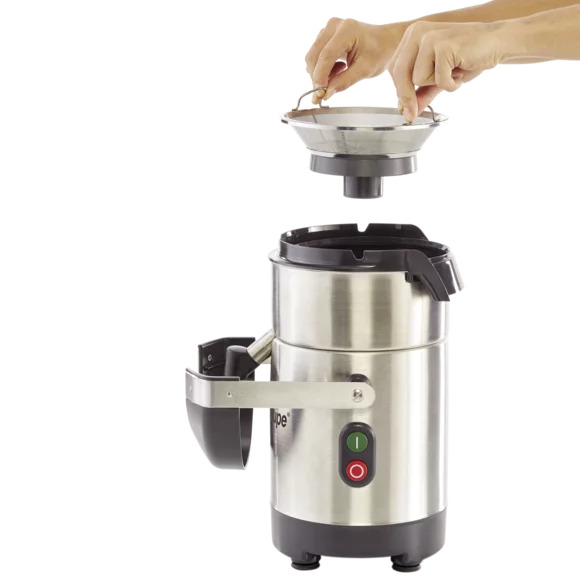
Robot Coupe J 100 – The right choice for intensive use
If your business needs to produce large volumes of fresh juice, the Robot Coupe J100 is the most suitable model. Designed for juice bars and supermarkets, it has a 1000 W motor, a reinforced grating disc for intensive use and an output of 160 litres per hour. It also offers two pulp ejection modes, continuous or into a 7.2-litre container, for optimal waste management.
Robot Coupe C 40 – For sauces and thick juices
The Robot Coupe C40 is a versatile machine, ideal if you work not only with fruit and vegetable juices but also with sauces. Its large-capacity hopper lets you process soft fruit and vegetables such as tomatoes, raspberries and blueberries. Perfect if you want to expand your offer with thicker juices or fresh sauces.
Easyline PB009 – The compact solution for small venues
If you have a small restaurant, bistro or bar with limited juice production, a more compact and affordable option is the Easyline PB009. This slow juicer works at low speed (37 rpm), delivering excellent juice quality without compromising nutrients. Built with a stainless steel and food-grade plastic body, it is sturdy and long-lasting. The wide 80 mm feed chute takes whole fruit and vegetables, cutting preparation time. It also comes with three stainless steel filters, including one specifically for making frozen desserts, making it a versatile solution for different food service needs.
Centrifuge or slow juicer: how to make the right choice for your business and get the best results
Choosing between a juice centrifuge and a slow juicer depends on the specific needs of your business. If you need speed and high production volumes, a centrifuge is the ideal option. If instead you are looking for superior quality, higher yield and juice that keeps better, a slow juicer is the right choice. With Robot Coupe models you can find the perfect solution for your business and offer your customers fresh, tasty juices. If your business has a smaller production volume and you are looking for a more compact and affordable option, the Easyline PB009 is a sound alternative, combining efficiency and practicality in a more accessible format.
SHOP NOW: