

























SHOP NOW:


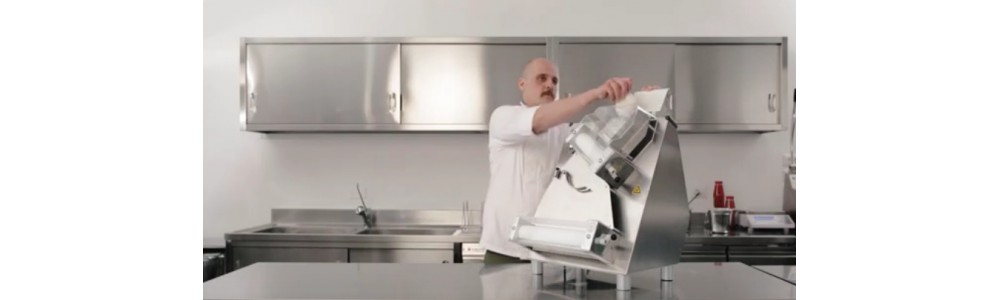
An electric pizza dough sheeter is the pizza rolling machine that replaces stretching dough by hand, speeding up the job without compromising the dough or the shape of the pizza. Among the best on the market are Fimar dough sheeters, which bring with them all the quality and efficiency of the company's restaurant and kitchen equipment. In this article we offer a comparison between single-roller dough sheeters and two-roller models, with angled or parallel rollers, so you can make an informed choice of the pizza roller that best meets your needs.
Before choosing a model, ask yourself whether you really need a dough sheeter
Many professionals start by comparing a single-roller dough sheeter with a two-roller one, but the first question should be a different one: does your pizzeria really need a professional dough sheeter?
The answer depends on your workload, the type of dough, how your pizza line is organised and your business goals. To understand when this equipment is a real operational advantage, read our guide:
Professional dough sheeter: when is it really worth using one in a pizzeria?
What is a pizza dough sheeter and what is it for?
A pizza dough sheeter is a semi-automatic machine for preparing pizza: more precisely, it rolls out the dough to the desired shape and 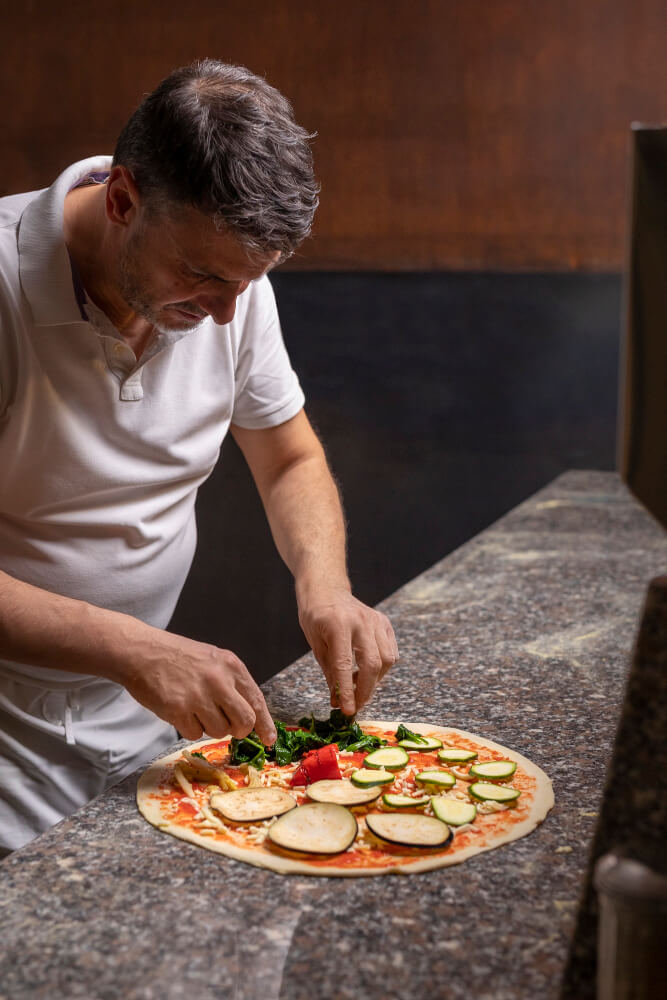 thickness. It is fitted with one or two stainless steel rollers that stretch and flatten the dough into an even, round shape.
Compared with working by hand, a dough sheeter simplifies and speeds up rolling out pizza dough, making it fast and consistent without changing the temperature of the dough. It is also versatile, as it can be used to roll out focaccia or piadina (Italian flatbread) dough, making it a very useful piece of equipment in many professional kitchens and indispensable where large quantities have to be produced.
Differences between single-roller, parallel two-roller and angled two-roller dough sheeters
As mentioned, a dough sheeter can have one or two rollers to stretch and flatten the dough into an even, round shape. There are also parallel-roller models, which are used when you want a rectangular shape, typical of pan pizza or focaccia sold by the slice.
While they share the same high-quality, sturdy and hygienic construction materials, stainless steel above all, single-roller dough sheeters differ from two-roller ones. Two-roller models in turn fall into two categories: parallel-roller and angled-roller dough sheeters.
Below is a detailed comparison between a single-roller dough sheeter and a two-roller dough sheeter to help you choose the best equipment for your deli or pizzeria.
Single-roller dough sheeter: features, uses, pros and cons
These are pizza rolling machines with a single roller that rolls out the dough.
Main features: they are compact models, perfect for small pizzerias or pizza-by-the-slice shops. They have a stainless steel frame and a single food-grade resin roller. The roller rolls out the dough efficiently, but may need a few more passes than a two-roller model.
How it works: the operator passes the dough through the roller once to obtain the desired thickness.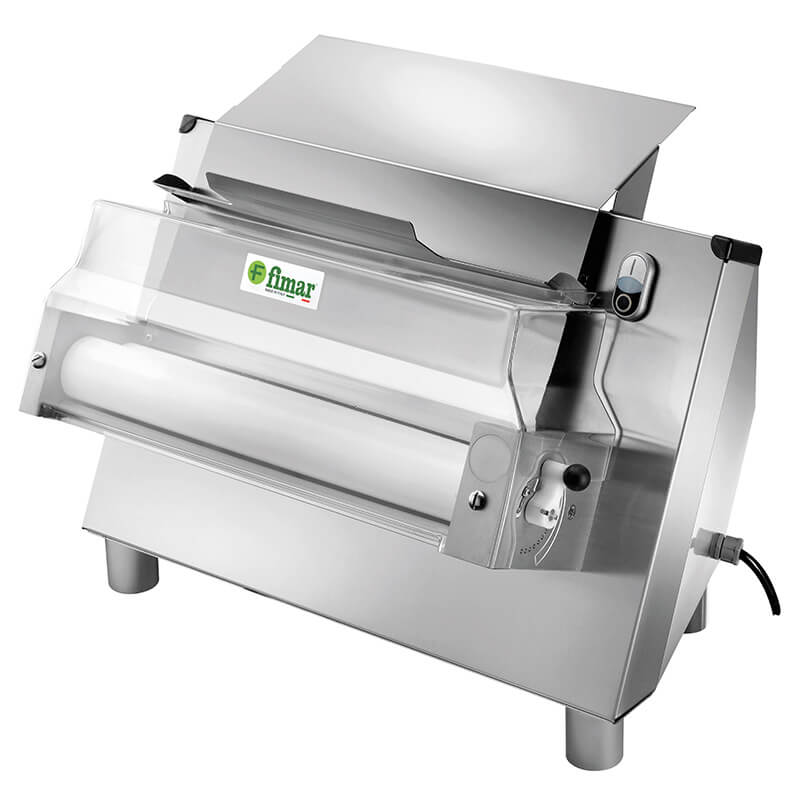
Speed: slower than two-roller models, as more manual passes are needed.
Pizza size: it can roll out pizzas from 30 cm to 40 cm in diameter, with thickness adjustable from 0 to 5.4 mm using the thickness adjustment lever.
Start-up: there are versions with manual start via a switch or foot pedal, and others with automatic start via sensors.
Maintenance: easy to carry out; it keeps the machine in good condition for a long time, as long as it is done regularly with suitable, non-aggressive products.
When we recommend it: this is the right model for anyone with limited space who produces a limited number of pizzas and wants an efficient, easy-to-use dough sheeter for occasional or low-volume production. It is also a model that can be bought for home use.
Two-roller dough sheeter: features, uses, pros and cons
These dough sheeters have two rollers placed one above the other at a set distance, generally longer than the single roller of the other model. They are available in two versions: parallel-roller and angled-roller dough sheeters.
How it works: the dough passes through the first roller for initial rolling, then through the second to set the thickness.
Adjustability: both rollers can be adjusted to obtain different shapes and thicknesses with greater precision.
Speed: faster than a single-roller model, because the operator can obtain an even sheet of dough in fewer passes.
Maintenance: easy to carry out; it keeps the machine in good condition for a long time, as long as it is done regularly with suitable, non-aggressive products. Watch this video to see the machine presented and in action.
SHOP NOW:
Parallel-roller dough sheeter
Main features: this type of dough sheeter is ideal for pan pizza, thanks to two consecutive parallel rollers of different sizes. They roll out the dough in a single pass, making them more efficient than single-roller models. 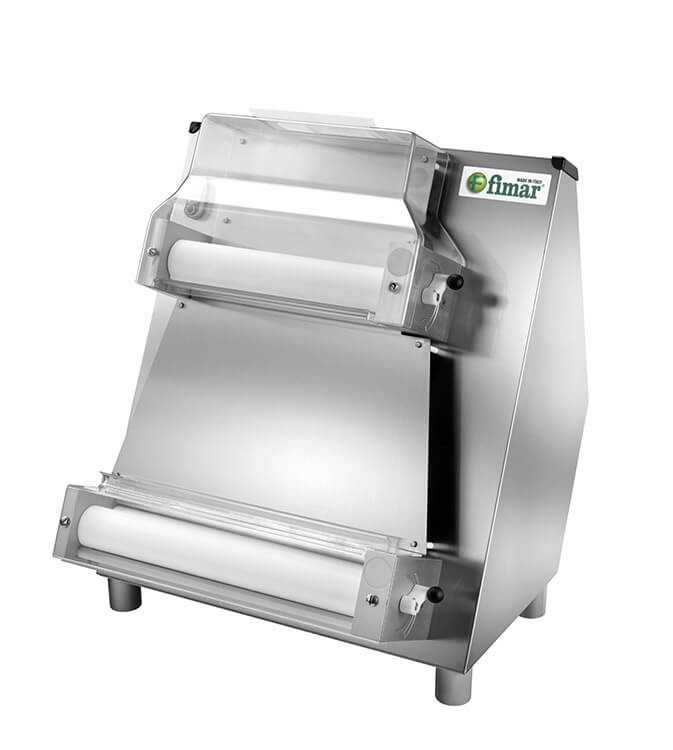
Use for round pizzas: although they are designed for pan pizza, they can also be used for round pizzas by turning the dough between one roller and the next.
Pizza size: they can produce pizzas up to 40 cm in diameter, with thickness adjustable from 0 to 5.4 mm using the thickness adjustment lever.
Start-up: models can have manual or automatic start, to suit different operating needs.
When we recommend it: an excellent model for businesses that make both pan pizzas and round pizzas, ideal if you need versatility and good output in a medium-sized or large kitchen.
Angled-roller dough sheeter
Main features: they have two angled rollers and a hook that automatically and quickly turns the dough between one roller and the next. They are designed for medium-sized and large pizzerias.
Use for round pizzas: perfect for producing round pizzas quickly and automatically, with no need to turn the dough by hand.
Pizza size: they roll out pizzas from 30 cm to 40 cm in diameter, with thickness adjustable from 0 to 5.4 mm using the thickness adjustment lever.
Start-up: the automatic mechanism allows faster processing, simplifying the job in kitchens with medium-to-high output of round pizzas.
When we recommend it: the ideal model for pizzerias that only serve round pizzas and need production efficiency rather than versatility, ensuring consistency and speed with little effort.
SHOP NOW:
Fimar single-roller dough sheeters: models available online at Cornerchef
The Fimar single-roller dough sheeter available in our online store is:
Fimar two-roller dough sheeters: models available online at Cornerchef
There are three Fimar two-roller models available in our online store, one with parallel rollers and two with angled rollers:
- Fimar FIP42N parallel two-roller dough sheeter
- Fimar FI/42 single-phase angled-roller dough sheeter
- Fimar FI32N angled-roller dough sheeter
Which Fimar dough sheeter is right for you: how to choose the right model
To choose between our single-roller and angled two-roller Fimar dough sheeters, consider the pros and cons of each model and weigh them against your own needs.
Advantages and disadvantages of the single-roller dough sheeter
The single-roller model has the following advantages:
- Compact size: it takes up less space, making it ideal for small kitchens or delis with limited room.
- Price: usually cheaper than two-roller models.
- Ease of handling: easy to use for smaller quantities of dough, suitable for businesses with limited pizza production.
On the other hand, its disadvantages are:
- Limited efficiency: not ideal for large volumes of dough or high-speed production, as the process requires more manual work.
- Consistency: the dough thickness may be less even than with a two-roller dough sheeter.
When we recommend a single-roller dough sheeter
We suggest buying and using this type of dough sheeter for:
- Small pizzerias or delis: ideal if you do not need to handle large volumes of dough.
- Occasional use: if the dough sheeter is used occasionally rather than for daily or high-paced production.
Advantages and disadvantages of the two-roller dough sheeter
Two-roller models, both parallel and angled, have the following advantages:
- Greater efficiency: ideal for high-paced production, as the dough can be worked quickly and evenly.
- Precision: the dough is more even thanks to the double rolling, ensuring a consistent thickness.
- Suitable for high volumes: perfect for pizzerias or delis with steady, large-scale pizza production.
Their disadvantages are:
- Price: generally more expensive than single-roller models.
- Footprint: it needs more space in the kitchen, so it is not always suitable for small delis.
- More maintenance: because of the double structure, it may need more frequent maintenance than a single-roller model.
When we recommend a two-roller dough sheeter
We suggest buying and using this type of dough sheeter for:
- High-output pizzerias: perfect if you need to roll out large volumes of dough quickly and efficiently.
- Kitchens with enough space: ideal when space is not an issue and you need a machine that ensures a steady workflow.
Still not sure which to choose? Ask us for advice
If, despite all this information, you still cannot reach a decision you are happy with, contact us to call or write to our customer service team and ask for advice, so you can clarify your ideas and buy with confidence.