


















SHOP NOW:


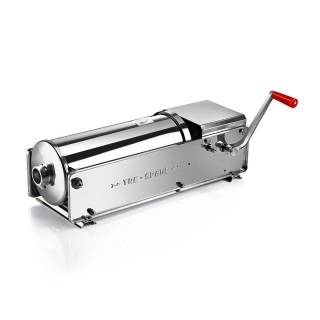


Talking about professional sausage stuffers without distinguishing between artisanal butcher shops and industrial production often leads to poor choices.
These two realities have very different goals, rhythms, and operational logics, which directly affect the type of machine, its size, and work organization.
Understanding these differences is essential to avoid oversized solutions or, conversely, equipment that is unsuitable for everyday work.
What distinguishes an artisanal butcher shop from industrial production?
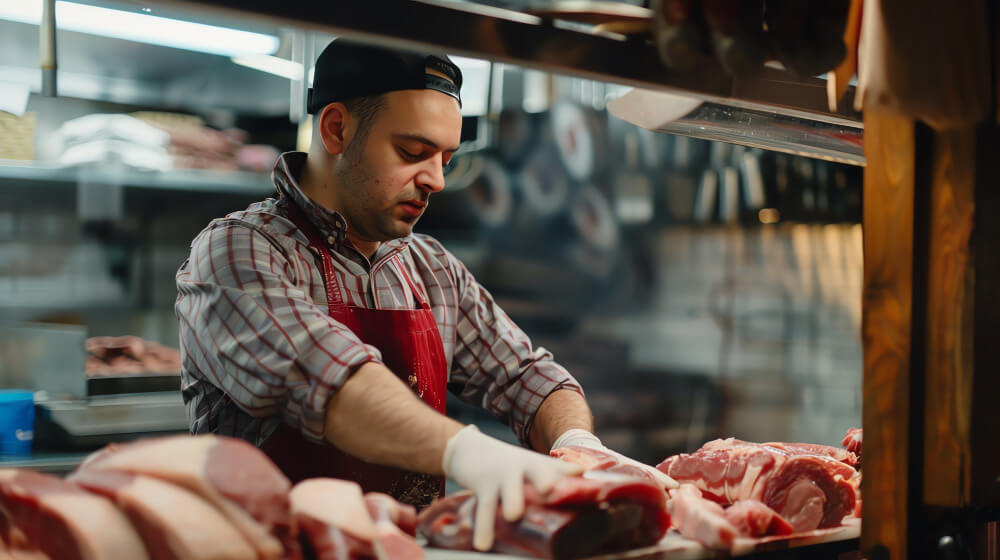
An artisanal butcher shop works with limited volumes, variable production, and often customized recipes.
Industrial production, on the other hand, focuses on continuity, standardization, and large quantities.
This difference in approach is directly reflected in the role of the sausage stuffer and how it is integrated into the production cycle.
What is the role of the sausage stuffer in an artisanal butcher shop?
In an artisanal butcher shop, the sausage stuffer is almost never a machine dedicated exclusively to a single product.
It is used for different processes, often non-continuous, and therefore must guarantee flexibility, ease of cleaning, and good manual control of the process.
For this reason, its integration should be planned from the outset within the framework of professional sausage stuffers in the design of a butcher’s laboratory, rather than being treated as a simple support machine added at a later stage.
Why are industrial requirements completely different?
In industrial production, the sausage stuffer often operates in a continuous line with meat grinders, mixers, and packaging systems.
Here, the priority is to maintain a constant flow, reduce downtime, and ensure uniformity across large volumes.
In this context, the machine becomes part of an automated chain, with requirements that are very different from artisanal ones.
How does the choice between manual and hydraulic sausage stuffers change?
In artisanal butcher shops, a manual sausage stuffer or a small hydraulic model is often sufficient to handle production.
The choice depends more on product variety than on absolute volume.
By contrast, in industrial settings the hydraulic sausage stuffer almost always becomes indispensable, as already explained in the article on the operational differences between manual and hydraulic sausage stuffers.
Cylinder capacity: why artisanal production does not follow industrial numbers
In artisanal contexts, an excessively large cylinder can become a limitation rather than an advantage.
Variable production and frequent changes in processing require machines that are easy to empty and clean, rather than high capacities.
This aspect is explored in detail in the article dedicated to cylinder capacity and its impact on daily work, which highlights how the choice should always start from the real operational context.
Hygiene and cleaning: why artisanal production requires even more attention
In artisanal butcher shops, the frequent alternation of products makes cleaning the sausage stuffer even more critical.
Changing mixtures, recipes, or processes requires fast and thorough sanitation to avoid cross-contamination.
This topic is also central to the article dedicated to cleaning and hygiene of professional sausage stuffers, which highlights common mistakes and best operational practices.
When does an artisanal butcher shop risk becoming “too industrial”?
A common mistake is adopting machines designed for industrial use without having adequate volumes or space.
This leads to unnecessary costs, management difficulties, and a work organization that lacks flexibility.
Design should instead adapt to the real scale of the business, as happens in tailor-made food laboratory design based on operational needs.
When does it make sense to concretely evaluate sausage stuffers for your business?
Only after clarifying whether the activity is artisanal or industrial does it make sense to compare the professional sausage stuffers best suited to your laboratory.
This way, the choice takes into account not only numbers, but also flexibility, cleaning, and day-to-day management.
SHOP NOW:
The right sausage stuffer is the one consistent with the production scale
There is no single “best” sausage stuffer in absolute terms.
There is the one that best matches the type of production, real volumes, and the identity of the business.
Understanding the difference between artisanal and industrial needs allows for smarter investments and the creation of a more efficient laboratory over time.