




















SHOP NOW:


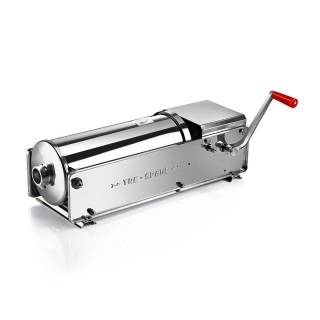


Cleaning a professional sausage stuffer is not a secondary task, but a critical phase of the production process.
Mistakes or superficial practices at this stage directly affect food safety, product quality, and compliance with HACCP procedures.
Many issues that emerge during inspections or in day-to-day laboratory management do not depend on the machine itself, but on how it has been integrated, used, and cleaned.
Why is the sausage stuffer a piece of equipment with high hygienic risk?
The sausage stuffer works in direct contact with raw mixtures, often rich in moisture and proteins.
These conditions make the machine particularly prone to bacterial growth if cleaning is not carried out correctly and consistently.
For this reason, the sausage stuffer is among the pieces of equipment that require strict sanitation procedures, starting from the laboratory design phase.
What are the most common mistakes in cleaning a sausage stuffer?
One of the most frequent mistakes is limiting cleaning to the visible parts only.
Dough residues can accumulate inside the cylinder, in the seals, or at connection points, creating areas that are difficult to sanitize.
Another common error is underestimating timing: cleaning “at the end of the day” is not always sufficient if the machine is used intensively.
Disassembly and accessibility: why do they matter more than they seem?
A sausage stuffer that is difficult to disassemble almost always leads to incomplete cleaning, especially in daily work where time and pace do not allow for complex procedures.
When disassembly and reassembly take too long or are inconvenient, operators inevitably tend to postpone or simplify the procedure, increasing hygienic risk.
For this reason, ease of disassembly should already be considered when evaluating professional sausage stuffers in the design of a butcher’s laboratory, and not only as a technical detail at the time of purchase.
What role does HACCP play in managing the sausage stuffer?
The HACCP system does not impose a single cleaning method, but requires that risk be controlled in a documentable way.
This means defining clear procedures, established frequencies, and specific responsibilities for sanitizing the sausage stuffer.
The same approach applies to other sensitive phases of the laboratory, such as packaging, where hygienic control is equally central, as explained in the management of vacuum packaging according to HACCP in the food laboratory.
Cleaning the sausage stuffer and layout organization
Proper hygiene does not depend only on procedures, but also on where and how the machine is positioned.
Restricted spaces, lack of dedicated water points, or interference with other processes make cleaning more complex and less effective.
This is one of the reasons why the sausage stuffer must be correctly integrated into the layout, as an integral part of the design of the food laboratory, and not added at a later stage.
How does cleaning affect the quality of the final product?
A properly cleaned sausage stuffer ensures greater product uniformity and reduces the risk of spoilage.
Residues or contamination can compromise the shelf life of the sausage and generate avoidable waste.
Cleaning, therefore, is not only a safety measure, but a direct factor in production quality.
When does it make sense to evaluate a sausage stuffer also in terms of hygiene?
Hygienic evaluation should take place before purchase, not after the first problems arise.
At this stage, it is useful to compare the professional sausage stuffers best suited to your laboratory, considering not only capacity and performance, but also materials, surfaces, and ease of cleaning.
Cleaning and hygiene as part of the process, not as a separate activity
Treating sausage stuffer cleaning as a secondary operation is one of the most common mistakes.
When it is integrated into the workflow, however, it becomes a sustainable routine and reduces the risk of non-compliance.
This approach distinguishes an improvised laboratory from a truly professional one.
SHOP NOW:
Sausage stuffer hygiene is a design responsibility
Cleaning the sausage stuffer does not depend only on the operator, but on upstream decisions.
Design, layout, machine selection, and procedures work together to ensure safety and quality over time.
This article completes the operational framework of the sausage stuffer cluster, complementing technical and production evaluations with hygienic considerations.