



















SHOP NOW:


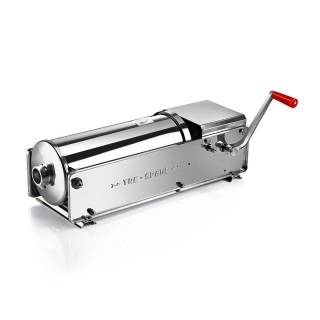



When it comes to choosing a sausage stuffer, the first real crossroads is not about brand or capacity, but about the operating system.
Manual sausage stuffers and hydraulic sausage stuffers follow very different operational logics and have a direct impact on productivity, operator fatigue, and work organization.
Understanding these differences is essential to avoid undersized or oversized choices compared to the real needs of the laboratory.
What is the fundamental difference between a manual and a hydraulic sausage stuffer?
The main difference between a manual and a hydraulic sausage stuffer lies in how pressure is applied to the mixture.
In the manual version, the force is generated by the operator via a lever or crank; in the hydraulic version, pressure is constant and provided by a motorized system.
This distinction directly affects work pace, production continuity, and stuffing quality.
When is a manual sausage stuffer a sensible choice?
A manual sausage stuffer is suitable for limited production, occasional processing, or artisanal laboratories with small volumes.
It allows good control over the mixture but requires continuous physical effort which, over time, can affect productivity and operator fatigue.
It is a coherent solution when the sausage stuffer is not a central phase of the production cycle.
In which cases does a hydraulic sausage stuffer become necessary?
A hydraulic sausage stuffer is recommended when production is continuous or when volumes make manual work unsustainable.
Constant pressure allows more uniform stuffing, reduces physical effort, and improves process repeatability.
In these contexts, choosing a hydraulic system is fully part of an evaluation of work organization and production continuity, not simple convenience.
How does the impact on the operator change between manual and hydraulic systems?
From an ergonomic standpoint, the difference is substantial.
A manual sausage stuffer requires strength and repetitive movement, while a hydraulic one allows the operator to focus on control, precision, and product handling.
This evaluation should already be made when analyzing professional sausage stuffers in the design of a butcher shop laboratory, as it affects work shifts, posture, and safety.
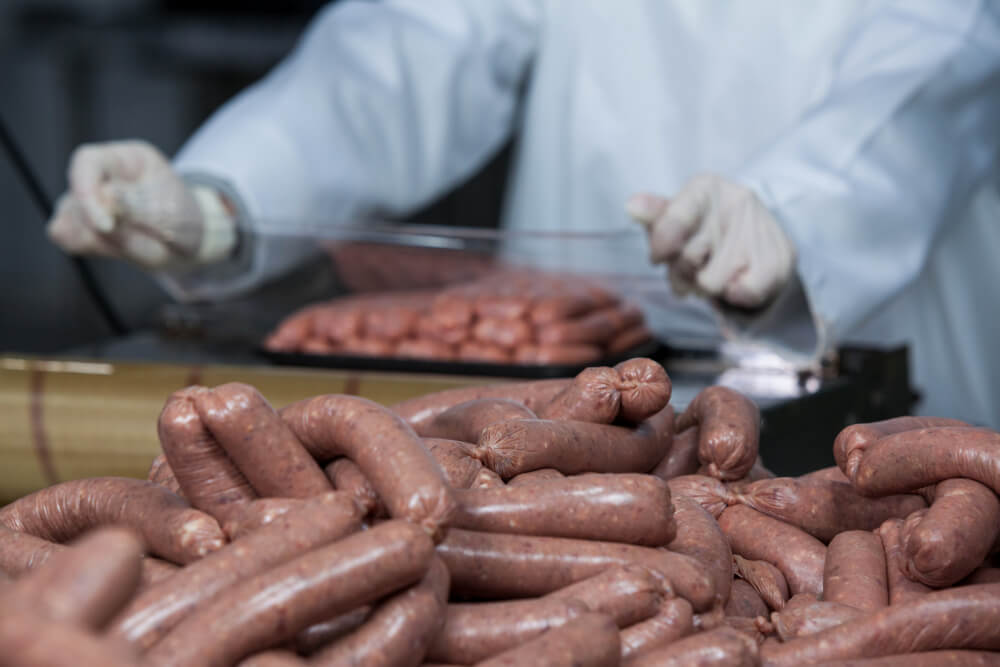
What is the relationship between the sausage stuffer and the meat grinder when choosing the system?
Sausage stuffers and meat grinders almost always operate in continuity.
If the meat grinder can handle high volumes but the sausage stuffer is manual, a bottleneck is created that slows down the entire process.
For this reason, the choice of stuffing system must be consistent with the processing line, as happens in the design of a professional meat grinder in a butcher shop laboratory.
Manual or hydraulic sausage stuffer: what changes for hygiene?
From a hygiene standpoint, both solutions can be compliant if used correctly.
However, a hydraulic sausage stuffer reduces processing time and handling, lowering the risk of contamination especially during longer production runs.
This aspect should be evaluated together with HACCP procedures, as with other sensitive phases of the laboratory, such as packaging, discussed in vacuum packaging management according to HACCP in the food laboratory.
When does it make sense to compare the available models?
Only after clarifying whether a manual or hydraulic system is more consistent with real work requirements does it make sense to evaluate the models available on the market.
At this stage, it becomes useful to compare the professional sausage stuffers best suited to your laboratory, taking into account capacity, footprint, and type of production.
What other aspects complete this choice?
The choice between a manual and a hydraulic sausage stuffer is only one of the first steps in the decision-making process.
In daily work, factors such as the capacity and cylinder of the sausage stuffer in everyday work, stuffing speed, and ease of cleaning are just as decisive, as they directly affect productivity, organization, and hygienic management of the machine.
These elements, often underestimated, are what truly make the difference between a theoretically correct choice and one that is genuinely functional in the laboratory.
SHOP NOW:
Manual or hydraulic: the choice depends on real work
There is no absolute best sausage stuffer.
There is only the one most consistent with production volume, laboratory organization, and available human resources.
Correctly evaluating the stuffing system means avoiding bottlenecks and building a smoother, more sustainable production process.