






















SHOP NOW:


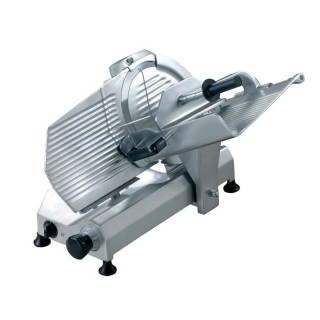



When designing or reorganizing a food laboratory, one of the most frequently asked questions concerns whether a professional slicer is mandatory.
Understanding when it is truly required, when it is simply recommended, and when it becomes an indirect responsibility is essential to avoid design and management mistakes.
In this context, the slicer should not be viewed as a matter of “presence or absence,” but as a choice linked to safety, hygiene, and the type of processing.
Is a professional slicer legally mandatory?
From a regulatory standpoint, there is no law that explicitly requires the installation of a professional slicer in a food laboratory.
Regulations instead focus on the objectives to be achieved: operator safety, product hygiene, and process control.
This is the same principle that guides the
proper design of a food laboratory,
where what matters is not the equipment itself, but the result it enables.
Why, then, does the slicer become “de facto” mandatory in many cases?
The requirement for a slicer emerges indirectly when the type of processing does not allow safety and hygiene to be ensured with alternative tools.
If manual cutting involves high risks for the operator or hygiene conditions that are difficult to control, the use of a professional slicer becomes the most appropriate solution.
In such cases, not installing one exposes the laboratory manager to critical issues during inspections and audits.
What role does HACCP play in choosing a slicer?
The HACCP system does not mandate specific pieces of equipment, but requires that risks be prevented and controlled.
When a slicer helps reduce the risk of contamination or injury compared to other operational methods, it becomes a choice consistent with the self-control plan.
The same risk-based approach also applies to other key laboratory equipment, such as vacuum sealing, where HACCP does not require a specific machine but does require proper procedures, process control, and conscious management of operational phases, as discussed in
vacuum sealing management according to HACCP in the food laboratory.
For this reason, in many laboratories, the slicer is included already at the design stage as a functional element for complying with procedures.
In which activities is a slicer strongly recommended?
In contexts such as butcher shops, delis, and food preparation laboratories, the slicer is often essential to ensure operational continuity and consistent quality standards.
When cutting volumes are high or repetitive, using manual tools is no longer sustainable, neither from a safety standpoint nor from an organizational one.
Here, the slicer becomes an integral part of the workstation, not an optional accessory.
Slicer and workplace safety: what responsibilities does the owner have?
The employer is required to provide equipment suitable for the type of work being carried out.
If the absence of a professional slicer increases the risk of injury, responsibility is not linked to the missing machine itself, but to the failure to prevent the risk.
This is one of the reasons why safety should be assessed before purchasing equipment, not after an accident has occurred. In many cases, injuries are not caused only by the absence of suitable machinery, but also by operational mistakes in the daily use of the equipment: we have analyzed the most frequent ones in the article dedicated to the most common mistakes in using slicers and managing workplace safety.
Is it possible to work without a slicer in a compliant way?
Yes, but only in specific and limited cases.
Activities with low volumes, occasional processing, or pre-portioned products may not require the use of a slicer, provided that safety and hygiene are still ensured.
As soon as work becomes continuous or structured, however, the absence of a slicer becomes a critical issue rather than a choice.
When does slicer selection become a design responsibility?
Slicer selection becomes a design responsibility when it directly affects layout, workflows, and safety.
This is the same approach discussed in the article dedicated to
the role of slicers in laboratory design,
where the machine is considered part of the system rather than an isolated element.
When does it make sense to concretely evaluate which slicer to install?
Only after clarifying whether the slicer is necessary from an operational and regulatory standpoint does it make sense to move on to evaluating specific models.
At that point, it becomes useful to compare the
professional slicers best suited to your laboratory,
based on space, volumes, and the type of product being processed.
The slicer as a “functional” obligation, not a regulatory constraint
Speaking of obligation in a strict sense is reductive.
In most cases, the professional slicer is a functional obligation, arising from the need to work safely, maintain hygiene, and ensure efficient organization.
Understanding this distinction allows for more informed decisions and the creation of laboratories that are solid over time.
SHOP NOW:
The obligation of the slicer stems from responsibility, not regulation
A professional slicer is not always legally mandatory, but it often becomes so due to technical and organizational responsibility.
Evaluating it correctly means preventing problems rather than solving them afterward.
This article explores the why behind the slicer; the next ones will address the how, analyzing operational differences, safety, and daily use.