




















SHOP NOW:
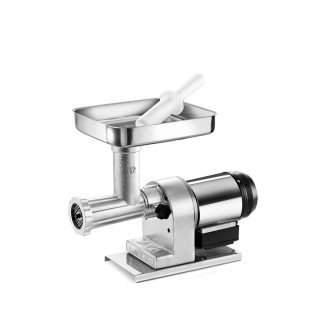
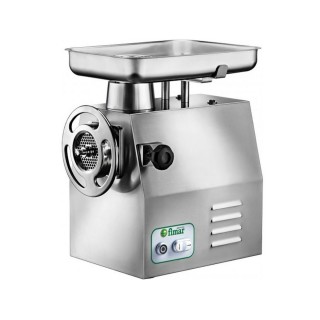

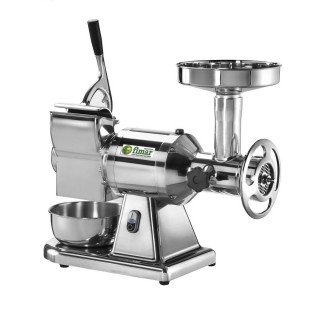


The professional meat grinder is often considered a piece of equipment “for butcher shops,” but in practice it is also used in many delicatessen laboratories.
The critical point is not where it is used, but how it is used and integrated into the workflow.
Butcher shops and delicatessens have different needs, and treating them the same way almost always leads to poorly functional compromises.
Why do butcher shops and delicatessens use the meat grinder differently?
In a butcher shop, the meat grinder is a central machine, used daily for the production of minced meat and preparations.
In a delicatessen, on the other hand, its use is more intermittent and linked to specific preparations.
This difference in rhythm and role completely changes how the meat grinder should be selected and managed.
The meat grinder in a butcher shop: continuity and control
In a butcher shop, the meat grinder is often used several times a day, with constant volumes and immediate customer demand.
Here, what matters is:
- operational continuity
- robust construction
- ease of quick cleaning
The meat grinder becomes a stable workstation within the production line, not an auxiliary machine.
This central role has already been highlighted in the design of the professional meat grinder in the food laboratory.
The meat grinder in a delicatessen: flexibility and integration
In delicatessen laboratories, the meat grinder is used for:
- fillings
- in-house preparations
- ready-to-eat products
The focus shifts from continuity to flexibility.
The machine must be easy to disassemble, quick to clean, and simple to integrate into spaces often shared with other processes.
How does the technical choice change between the two contexts?
In butcher shops, it is common to choose more structured meat grinders, with feed openings suited to constant volumes.
In delicatessens, instead, a more compact machine is often preferable—one that does not monopolize space and can be used only when needed.
This technical evaluation is closely linked to the performance aspects discussed in the article on feed opening, plate, and power of the meat grinder in daily work.
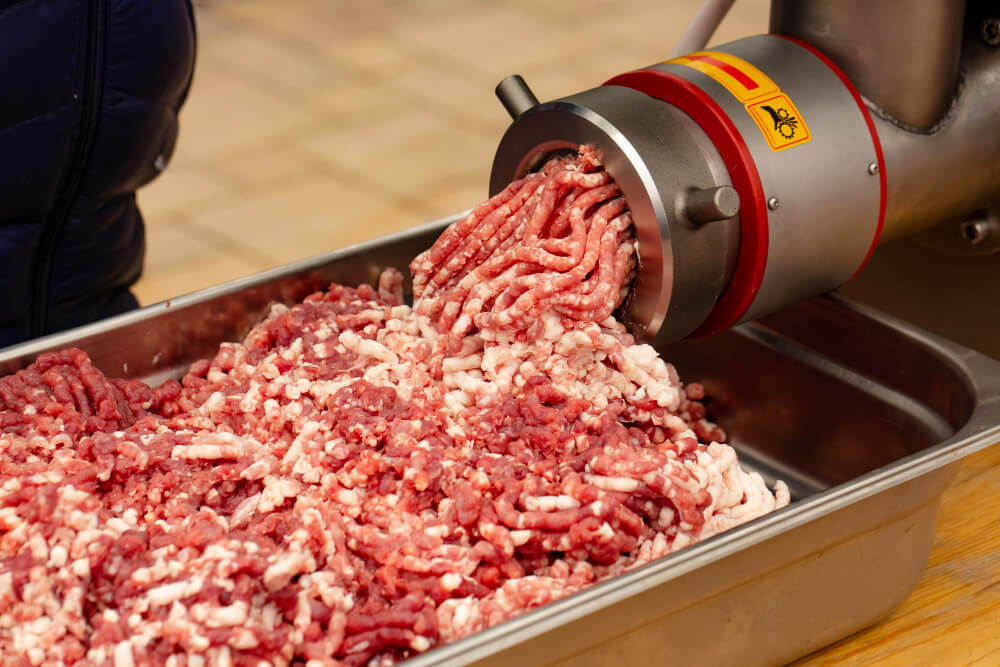
Hygiene and meat grinder management: same principles, different applications
The hygienic principles are the same, but their application differs.
In butcher shops, cleaning must be frequent and integrated into the production flow; in delicatessens, it is often linked to changes in preparation.
In both cases, poor cleaning management quickly becomes a problem, as explained in the article on cleaning and hygiene of the professional meat grinder.
When does a delicatessen risk “thinking like a butcher shop”?
A common mistake is adopting solutions designed for butcher shops in a delicatessen context.
Machines that are too large or too specialized end up complicating work instead of simplifying it.
The choice should always start from the actual type of use, not from the equipment itself.
When does it make sense to compare meat grinders for your context?
Only after clarifying whether the activity is oriented toward a butcher shop or a delicatessen does it make sense to compare the professional meat grinders best suited to your laboratory.
In this way, the machine is chosen for the work it actually needs to do, not for what it “could do.”
The right meat grinder is the one consistent with the context
There is no single best meat grinder in absolute terms.
There is the one most consistent with the type of laboratory, volumes, and work rhythm.
Understanding the differences between butcher shops and delicatessens helps avoid poor investments and build a more balanced laboratory.
SHOP NOW:
Production coherence is the real professional choice
Choosing the right meat grinder means adapting the machine to the context, not the other way around.
When equipment follows real work, the laboratory functions better, with less stress and more control.
This article closes the meat grinder cluster, providing a complete view that brings together design, regulations, technical aspects, hygiene, and operational context.