




















SHOP NOW:
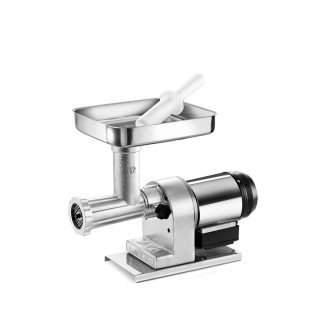
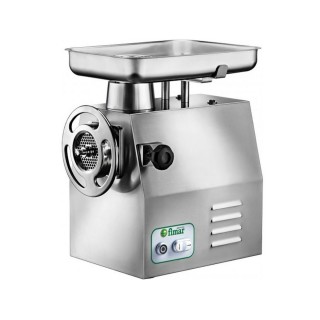

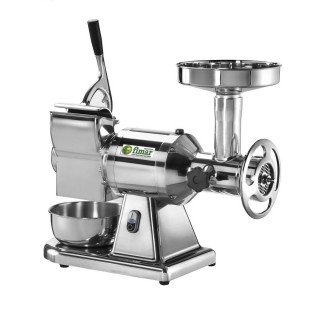



When evaluating a professional meat grinder, attention often focuses on motor power.
In reality, feed opening, grinding plate, and power work together, and considering them individually almost always leads to choices that are poorly aligned with real-world use.
In the daily routine of a butcher shop or food processing lab, it is the balance between these three elements that determines continuity, mince quality, and operator comfort.
Why is the size of the feed opening more than just a matter of speed?
The grinder’s feed opening determines the size of the pieces that can be inserted without excessive pre-cutting.
An undersized opening forces the operator into constant preliminary trimming, slowing the process and increasing meat handling.
A properly sized opening, on the other hand, simplifies workflow and makes grinding more consistent, especially when working with fresh meat of uneven cuts.
Feed opening size and workbench organization
A correctly sized feed opening also affects workbench organization.
Reducing intermediate steps means:
- fewer movements
- fewer tools
- fewer surfaces to sanitize
This aspect becomes central in the design of a food processing laboratory, where every detail impacts overall order and cleanliness.
What role does the grinding plate play in minced meat quality?
The grinding plate is not just about “deciding how fine” the grind will be.
It affects the structure of the mixture, yield, and consistency of results.
Plates that are not suited to the type of processing can:
- compress the meat
- overheat it
- compromise the final texture
In daily operations, these effects become especially evident when minced meat is a stable part of the product offering.
Grinding plate and product type: why there is no single solution
Meat for burgers, sauces, fillings, or stuffing requires different characteristics.
Using the same plate for different processes is one of the most common mistakes, especially in labs producing multiple types of preparations.
This variability must be considered already at the grinder selection stage, particularly when the machine operates in continuity with sausage stuffers.
Meat grinder power: when is it really needed?
Power should not be viewed as an absolute value.
A powerful motor on a poorly sized machine risks stressing the meat, while power that is balanced with feed opening and plate ensures smooth grinding.
In practical terms, more power does not automatically mean higher productivity.
The relationship between power and continuous operation
The real difference emerges during continuous processing.
A properly sized meat grinder maintains consistent output even after repeated cycles, without performance drops or overheating.
This is crucial in contexts where minced meat is produced several times a day, as already highlighted in the article on when a meat grinder is necessary in a butcher shop.
Feed opening, plate, and power within the processing line
When the grinder feeds subsequent stages, such as stuffing, the balance between these elements becomes even more important.
An irregular or overheated grind creates downstream issues, slowing the entire process and compromising production continuity.
This relationship is central to the discussion on professional sausage stuffers in laboratory design, where the grinder represents the first link in the chain and directly affects the efficiency of subsequent operations.

How to avoid the most common mistake when choosing a meat grinder
The most frequent mistake is choosing a grinder based on a single parameter.
Feed opening, plate, and power must be evaluated together, based on:
- real production volumes
- frequency of use
- type of product
Only in this way does the machine become real support for daily work.
When does it make sense to compare available models?
Once these aspects are clear, it is appropriate to compare the professional meat grinders best suited to your laboratory, evaluating the machine’s overall balance rather than a single technical specification.
Technical balance is what makes a meat grinder work well
A well-sized meat grinder operates continuously, neatly, and predictably.
When feed opening, plate, and power are aligned, the machine stops creating problems and becomes a natural part of the workflow.
SHOP NOW:
The right performance is the one you don’t notice
In a laboratory that works well, the meat grinder is never the center of attention.
It does its job without slowing things down, without stressing the meat, and without requiring constant adjustments.
That is precisely the sign of a correct choice.