



















SHOP NOW:


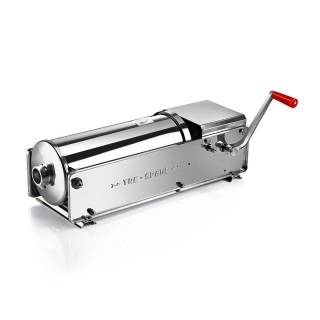


When evaluating a professional sausage stuffer, one of the most underestimated aspects is the cylinder capacity.
Attention often focuses on the operating system or the brand, but capacity is what determines work pace, production continuity, and the number of interruptions during stuffing.
Understanding what really changes between a small cylinder and a larger one helps avoid mistakes that, over time, affect the organization of the entire laboratory.
What is meant by the cylinder capacity of a sausage stuffer?
Cylinder capacity indicates the amount of mixture the sausage stuffer can hold and process in a single cycle.
This value directly affects the number of refills required and the smoothness of the operation, especially in continuous production.
It is therefore not just a “catalog specification,” but an operational parameter that must be considered in relation to real working conditions.
Why does cylinder capacity affect productivity?
A small-capacity cylinder forces frequent refilling, interrupting workflow and increasing downtime.
Conversely, an adequate capacity allows for more continuous production, reducing pauses and improving overall line efficiency.
This aspect becomes crucial when the sausage stuffer is a stable phase of the production cycle, as already highlighted in the role of professional sausage stuffers in the design of a butcher shop laboratory.
Cylinder capacity and production volumes: how should they be matched?
The choice of capacity should be based on average production volumes, not on occasional peaks.
An oversized sausage stuffer takes up unnecessary space in daily operations, while an undersized one quickly becomes a bottleneck.
Properly assessing volumes means designing a balanced workstation that is consistent with the rest of the equipment.
How does the operator’s work change with different cylinder capacities?
With smaller cylinders, the operator is forced to stop stuffing frequently to reload the machine.
This leads to increased fatigue, loss of concentration, and less consistency in the final result.
An appropriate capacity, on the other hand, allows for smoother work, improving both operator comfort and the quality of the stuffed product.
What is the relationship between sausage stuffer cylinder capacity and the meat grinder?
The sausage stuffer and meat grinder must be sized consistently with each other.
If the meat grinder produces mixture faster than the sausage stuffer can process it, a buildup occurs that slows down the entire line.
For this reason, cylinder capacity must be evaluated together with meat grinder performance, as happens in the design of the professional meat grinder in a butcher shop laboratory.
Cylinder capacity and hygiene: an often overlooked aspect
A cylinder that is too large, when only partially used, can create issues in mixture management and cleaning.
Conversely, a well-calibrated capacity facilitates complete emptying, sanitation, and compliance with hygiene procedures.
This topic is directly linked to HACCP management of equipment, just as in subsequent processing and packaging stages discussed in the management of vacuum packaging according to HACCP in the food laboratory.
When does it make sense to compare sausage stuffers based on capacity?
Only after clarifying:
- average volumes
- work organization
- integration with other equipment
does it make sense to compare the professional sausage stuffers best suited to your laboratory based on cylinder capacity.

What other factors complete the choice of a sausage stuffer?
Cylinder capacity is a fundamental parameter, but it is not the only factor that affects the efficiency of a sausage stuffer in daily work.
Aspects such as stuffing speed, ease of disassembly, and cleaning and maintenance of the professional sausage stuffer play an equally decisive role in operational continuity, hygiene, and long-term sustainability of work.
These are precisely the factors—often considered only after purchase—that make the difference between a machine that is theoretically suitable and one that is truly functional in the laboratory.
SHOP NOW:
The right capacity is the one that follows the laboratory’s rhythm
Choosing the correct cylinder capacity means working with continuity, order, and greater process control.
A well-sized sausage stuffer adapts to the laboratory—it does not force the laboratory to adapt to it.
This is one of the aspects that distinguishes an improvised choice from a truly professional one.