



















SHOP NOW:


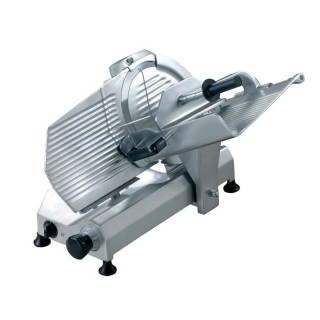
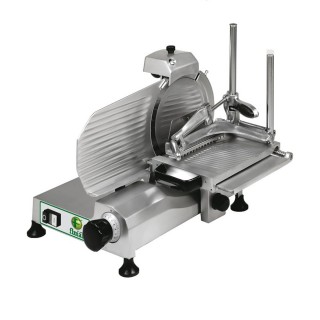
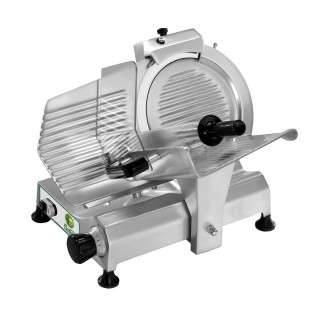



When moving from laboratory design to the actual choice of a slicer, one of the most frequent questions concerns the difference between a gravity slicer and a vertical slicer.
This is not an aesthetic or price-based distinction, but two different operational approaches that affect posture, speed, type of product processed, and workbench organization.
Understanding these differences is essential to avoid choices that may seem correct on paper but prove unsuitable for daily operations.
What really distinguishes a gravity slicer from a vertical slicer?
The main difference between a gravity slicer and a vertical slicer lies in how the product is supported and pushed toward the blade.
In the gravity version, the weight of the product facilitates forward movement, while in the vertical version the operator fully guides the cut.
This distinction directly affects control, precision, and work rhythm, especially in professional environments.
When is a gravity slicer more functional?
A gravity slicer is particularly suitable when working with cured meats, cheeses, and products of standard size.
The natural push of the product reduces operator effort and allows for continuous, consistent slicing, ideal for medium to high volumes.
It is often chosen when the priority is operational speed rather than millimetric control of the cut.
In which cases does a vertical slicer offer concrete advantages?
A vertical slicer is preferred when working with irregular products, large cuts, or foods that require greater control.
The vertical positioning allows the operator to manually manage pressure and feed rate, improving precision.
For this reason, it is widely used in butcher shops and laboratories where product variety is high.
How does ergonomics change between gravity and vertical slicers?
From an ergonomic standpoint, gravity and vertical slicers create different working modes that directly affect posture, fatigue, and operational continuity.
Gravity reduces effort in repetitive tasks, while the vertical slicer requires a more active posture but offers greater control of the cutting action. For this reason, ergonomics should not be evaluated after installation, but already when analyzing
professional slicers in food laboratory design, correctly defining workstation layout, heights, and maneuvering space.
Which type integrates better into the laboratory layout?
Integrating a slicer into the laboratory layout depends on the relationship between footprint, workflow, and available operating space.
A gravity slicer requires more frontal space for the carriage and product movement, while a vertical slicer, although more compact in depth, requires a well-designed workstation to ensure operator freedom of movement. This is why the choice directly affects workbench organization and workflow and must be addressed within a
proper food laboratory layout design.
Gravity or vertical slicer: what changes in terms of safety?
From a safety perspective, both types can be compliant if correctly integrated into the work cycle and used properly.
The vertical slicer often provides a greater perception of control over the product, while the gravity slicer reduces forced and repetitive movements; however, safety depends not only on the machine itself but also on training, maintenance, and workstation organization. This topic is closely related to what is discussed in the article
professional slicer: when it is mandatory and when it is not,
where the concept of obligation arises more from operational responsibility than from regulation.
When does it make sense to concretely compare available models?
Only after clarifying which type of slicer is needed does it make sense to compare models and configurations.
At this stage, it becomes useful to evaluate the
professional slicers best suited to your laboratory,
based on space, volumes, and type of use.
Which insights complete this choice?
The choice between a gravity and a vertical slicer is only one step in the decision-making process.
To arrive at a truly informed evaluation, it is also necessary to explore aspects such as blade diameter, operational safety, and maintenance—elements that affect daily work just as much as the type of machine itself. This is where the in-depth article on
slicer blade diameter and its impact on daily work
will begin, completing the technical framework for this choice.
The right slicer is the one that matches real work conditions
There is no universally best slicer.
There is the one most consistent with the type of product, work rhythm, and laboratory organization.
Understanding the operational differences between gravity and vertical slicers means making an informed choice, avoiding forced adaptations and long-term inefficiencies.
SHOP NOW:
The choice between a gravity and a vertical slicer depends on real work needs
Gravity slicers and vertical slicers respond to different requirements.
Evaluating them correctly makes it possible to design a more efficient, safer, and sustainable workstation.