



















SHOP NOW:


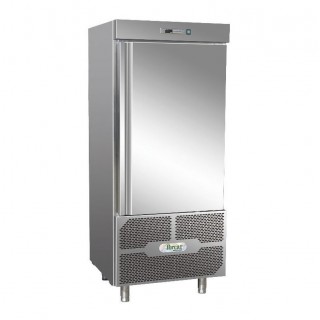


Restaurants, catering operations and butcher shops have different needs, and treating them the same often leads to inefficient choices.
Understanding these differences helps you choose and use the blast chiller in a way that is more consistent with real operations.
Is the blast chiller used in the same way in restaurants, catering and butcher shops?
No, the blast chiller is used differently depending on the context: in restaurants it is linked to service, in catering to continuous production, and in butcher shops to supporting processing activities.
Why is the blast chiller not used the same way in all contexts?
Each laboratory has a specific organization, with different rhythms, volumes and types of products.
The blast chiller adapts to these variables, but only if it is chosen and used correctly.
The same machine can be central in one context and secondary in another, depending on its role within the production flow.
The blast chiller in restaurants: service management
In restaurants, the blast chiller is often used for:
- advance preparations
- service management
- kitchen organization
It allows work to be done in advance and reduces pressure during peak times, improving service continuity and quality.
The blast chiller in catering: production continuity
In catering laboratories, the blast chiller plays an even more central role.
Production is often continuous and requires precise temperature management to ensure safety and preservation.
In this context, the blast chiller becomes a key tool for maintaining consistent standards and handling large volumes.
The blast chiller in butcher shops: support for processing
In butcher shops, the blast chiller is mainly used as support for processing activities.
It is used to:
- rapidly cool preparations
- stabilize products
- improve preservation
It is not always the main machine, but becomes essential when more structured processes are introduced.
How does the choice of blast chiller change across these contexts?
The choice cannot be the same for everyone.
In restaurants, flexibility matters; in catering, continuity; in butcher shops, integration with other processes.
This evaluation fits within the context of blast chiller integration in food laboratory design, where each piece of equipment must align with the workflow.
Blast chiller and workflow organization: a common factor
Despite the differences, there is one common element:
the blast chiller always impacts workflow organization.
It allows you to:
- separate production and service
- reduce peak workloads
- improve time management
The role of food safety in different contexts
In all cases, the blast chiller contributes to food safety, but in different ways.
In restaurants it is linked to service, in catering to production, and in butcher shops to product stabilization.
This temperature management is also central in vacuum packaging management according to HACCP in the food laboratory, where process control is essential.
When does the blast chiller become essential?
It becomes essential when:
- volumes increase
- processes become more structured
- there is a need to improve quality
In these cases, it is no longer just support equipment, but a central part of the process.
How to choose a blast chiller based on the type of business?
To choose a blast chiller, it is necessary to evaluate the operational context, volumes and the role of the machine within the workflow.
How to choose a blast chiller based on your context?
The choice must start from the type of business.
Only after defining the context does it make sense to compare the blast chillers best suited to your laboratory, avoiding standardized solutions.
SHOP NOW:
There is no universally best blast chiller
Each context requires a different solution.
A blast chiller perfect for a catering lab may be inefficient in a restaurant or a butcher shop.
The right choice is always the one most consistent with real operations.
The right blast chiller is the one that adapts to the laboratory
When the blast chiller fits the context, work becomes smoother, more organized and safer.
And it is precisely this consistency that determines process quality.