




















SHOP NOW:


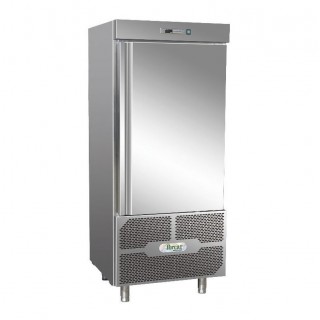



When designing a food laboratory, the blast chiller is one of the pieces of equipment that most significantly impacts time management, product safety, and overall workflow organization.
It is not an accessory machine, but a critical control point that connects production, storage, and service.
For this reason, the blast chiller should not be added later, but considered from the beginning as an integral part of the design.
Why is the blast chiller essential in food laboratory design?
The blast chiller is essential because it allows control over time and temperature, improving safety, quality, and workflow organization in the food laboratory.

Why is the blast chiller central in the modern laboratory?
In the daily operations of gastronomy, food service, and advanced butcher shops, the blast chiller allows controlled rapid cooling of food.
This process is not only for preservation, but for maintaining product quality, safety, and stability over time.
Without a properly integrated blast chiller, it becomes difficult to organize advance production and ensure consistent standards.
At what stage of the design should the blast chiller be included?
The blast chiller should be planned during the layout phase, together with other equipment managing product flow.
Adding it later often leads to:
- disorganized workflows
- compromised spaces
- operational inefficiencies
This approach aligns with the general logic of food laboratory design, where each machine must interact with the others.
Where should the blast chiller be positioned in the workflow?
The blast chiller is positioned between the production phase and the storage or service phase.
A correct placement:
- reduces transfer time
- prevents contamination
- improves workflow organization
When properly integrated, it becomes a natural step in the process, not an interruption.
Blast chiller and HACCP: why it is a critical point
From an HACCP perspective, the blast chiller is a key tool for temperature control, one of the most sensitive parameters in food safety.
Rapidly cooling food reduces the time in which bacterial growth can occur.
This principle is directly connected to overall laboratory management, as explained in vacuum packaging management according to HACCP in the food laboratory, where time and temperature are crucial factors.
Blast chiller and production organization
One of the most concrete effects of a blast chiller is the ability to separate production and service.
Preparing in advance, chilling, and storing allows for more consistent work and less pressure during peak times.
This completely changes laboratory organization, making it more stable and predictable.
In which contexts does the blast chiller become essential?
The blast chiller is particularly relevant in:
- delis with advance production
- restaurants with complex preparations
- laboratories operating in multiple stages
In these contexts, it is not just useful, but becomes necessary to maintain high standards.
The topic of obligation is explored in the article on when a blast chiller is mandatory, clarifying the difference between regulation and operational necessity.
Blast chiller and production process continuity
A laboratory without a blast chiller is forced to work “in real time,” with little flexibility and higher risk of error.
With a blast chiller, the process becomes modular: production, chilling, and later use.
This continuity is what distinguishes an organized laboratory from one working under constant pressure.
When is a blast chiller truly necessary?
A blast chiller becomes necessary when production is structured in multiple stages, requires high food safety, and must be managed in a planned way.
When does it make sense to choose the blast chiller model?
Only after defining:
- production volumes
- type of preparations
- workflow organization
does it make sense to evaluate available models and compare the blast chillers best suited to your laboratory, avoiding choices based solely on isolated technical specifications.
The blast chiller as a design choice, not an accessory
The blast chiller is a machine that changes the way you work, not just how you preserve food.
Integrating it correctly into the design means building a more efficient, safe, and organized laboratory.
This article represents the cornerstone of the blast chiller cluster, from which all technical, regulatory, and operational insights develop.
SHOP NOW:
Time organization starts with temperature control
In the modern laboratory, temperature control also means time control.
The blast chiller allows planning, anticipation, and stabilization of processes, transforming a reactive workflow into an organized one.
And this is where the difference lies between a kitchen that chases the workload and one that controls it.