





















SHOP NOW:


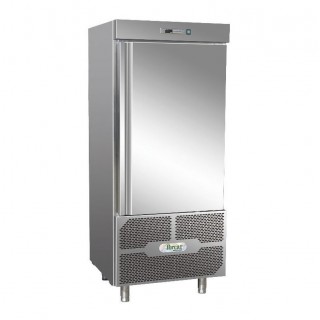



When choosing a blast chiller, attention is often focused on brand or price.
In practice, however, it is capacity, chilling time and cycles that truly determine the machine’s efficiency in daily operations.
Understanding these elements helps avoid bottlenecks, improve organization, and make the most of the blast chiller.
What determines the performance of a blast chiller?
The performance of a blast chiller depends on capacity, chilling time, and available cycles, which define its efficiency in daily operations.
Why is blast chiller capacity not just a matter of space?
Capacity is often associated with the number of trays, but in reality it directly affects production management.
An undersized blast chiller compared to actual volumes forces repeated processing and slows down workflow.
On the other hand, adequate capacity allows continuous operation, reducing downtime and intermediate steps.
Capacity and workload: the direct link
Capacity must be aligned with real laboratory volumes, not theoretical ones.
A laboratory with continuous production has different needs compared to one working on peaks or scheduled preparations.
This evaluation fits into the broader context of blast chiller integration in food laboratory design, where each piece of equipment must be sized according to real operations.
Chilling time: what does it really indicate?
Chilling time represents how quickly the machine brings food to the desired temperature.
It is not just a technical parameter, but a factor that directly affects food safety and workflow organization.
Faster times allow you to:
- reduce bacterial risk
- speed up processing
- increase productivity
Chilling cycles: why are they essential?
Professional blast chillers offer different cycles, generally divided into positive and negative chilling.
These cycles allow the machine to adapt to different processes, avoiding standardized treatment for different products.
Choosing the correct cycle affects:
- product quality
- food structure
- time management
How do capacity, time and cycles impact daily operations?
In real operations, these three elements work together.
A blast chiller with good capacity but slow times can slow production, while a fast but undersized machine creates accumulation.
It is the balance between these factors that determines operational efficiency.
Blast chiller and production organization
A properly sized blast chiller allows you to:
- plan production
- reduce workload peaks
- improve staff management
This aspect is directly linked to temperature management in the laboratory, as already discussed in vacuum packaging management according to HACCP in the food laboratory, where timing and control are essential.

When does a blast chiller become a bottleneck?
A blast chiller becomes a limitation when:
- it cannot handle the volume
- it has excessively long times
- it is not aligned with the workflow
In these cases, instead of helping, it slows down the entire process.
Why can a blast chiller slow down operations?
A blast chiller slows down operations when it is not properly sized, has excessively long times, or is not aligned with the laboratory’s production flow.
How to choose the right blast chiller based on these parameters?
The choice should start from:
- real production volumes
- frequency of use
- type of processing
Only then does it make sense to compare the blast chillers best suited to your laboratory, evaluating the consistency between technical features and real usage.
Performance and organization: a necessary balance
A high-performing blast chiller is not the most powerful one in absolute terms, but the one most aligned with the laboratory workflow.
Capacity, time and cycles must be balanced to ensure continuity, quality and safety.
An efficient blast chiller is one that doesn’t slow down the workflow
When the machine is properly sized, the process becomes smooth and predictable.
And it is precisely this continuity that makes the difference between an organized laboratory and one that operates in constant urgency.