




















SHOP NOW:


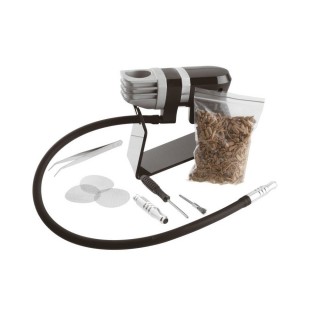

Professional smoking is often perceived as a process capable of adding value to a product and differentiating the offer. In the operational reality of a deli or a butcher shop, however, it is not a decision to be taken lightly.
Integrating smoking means adding a processing phase that affects organization, food safety, and time management.
This article aims to clarify when smoking is a sensible choice and when, instead, it risks unnecessarily complicating daily operations. The perspective is technical and practical, designed for those who are planning or reorganizing a professional food laboratory, in continuity with the guide dedicated to laboratory design and the selection of equipment for delis and butcher shops.
SHOP NOW:
What professional smoking really is (and what it is not)
In a professional context, smoking is not a simple “secondary” flavoring. It is a controlled process that modifies the product from a sensory point of view and requires precise operating conditions.
Unlike domestic or improvised solutions, smoking in a professional laboratory involves:
- temperature control
- smoke management
- defined exposure times
- separation of work phases
When these elements are missing, smoking loses its technical value and becomes a difficult variable to manage.
Cold smoking and hot smoking: real operational differences
The distinction between cold smoking and hot smoking is not merely theoretical but directly affects laboratory organization.
Cold smoking is mainly used to flavor ready-made or cured products. It does not cook the food and requires very careful management of environmental conditions, because the product remains in its initial microbiological state.
Hot smoking, on the other hand, combines smoking with heat treatment. It is a more structured process that affects product safety and must be planned more carefully within the production flow.
Choosing a technique without evaluating the operational context is one of the most common mistakes.
Which products are actually smoked in delis and butcher shops
In a professional laboratory, not everything that “can be smoked” is suitable for continuous processing. Professional smoking is applied only to specific product types, depending on the type of business and workload volume.
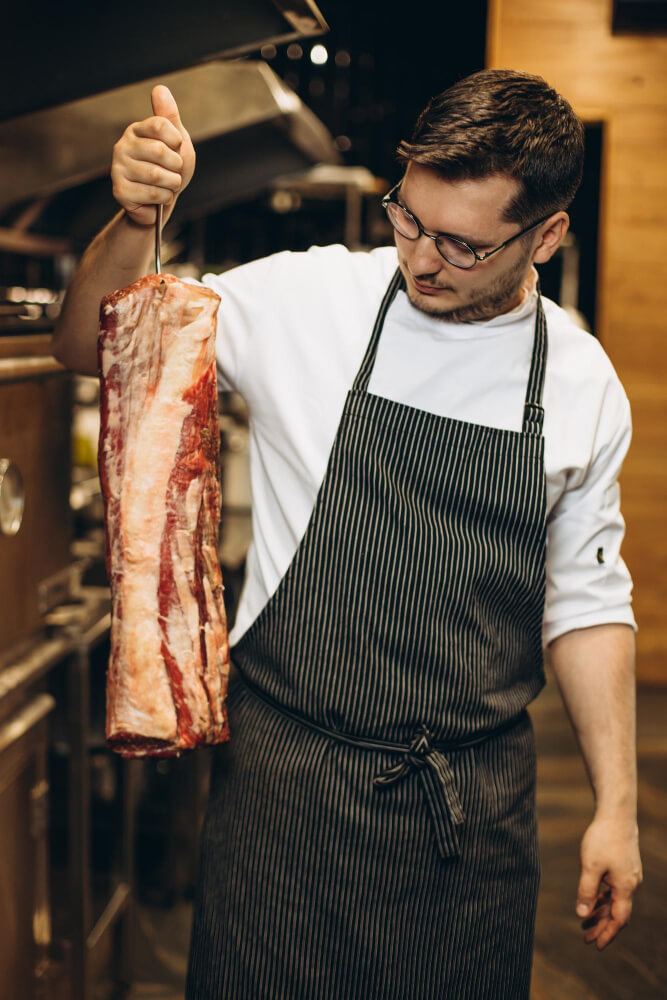
In butcher shops, smoking mainly involves meats and preparations intended for direct sale. In delis, instead, it is often used for fish, cheeses, and ready-made or semi-finished products.
Each product introduces specific requirements in terms of timing, handling, and storage. Thinking of smoking as a universal technique, applicable indiscriminately, often leads to solutions that are not sustainable over time.
Smoking and food safety: what really changes in the HACCP plan
Integrating smoking into a food laboratory means intervening in the HACCP plan, not simply adding a piece of equipment.
Smoke, temperature management, and product residence times become critical control points. In practice, many issues do not arise from the smoker itself, but from a lack of separation between processes or from an approximate handling of intermediate steps.
When smoking is introduced without revising the HACCP plan, the risk is creating critical issues that are difficult to manage later. For this reason, this process should be planned already during the laboratory design phase, not added as an improvised solution.
When a laboratory is truly ready to introduce smoking
A laboratory is truly ready to introduce smoking only when its core processes are already under control. If preparation, preservation, and storage phases are not clearly defined, adding smoking does not create value but increases operational complexity.
In many laboratories, the most frequent mistake is considering smoking as a simple extension of the product range. In reality, however, it means adding a phase that requires dedicated time, separate spaces, and careful temperature management. When these elements have not been planned, the smoker often ends up being used sporadically or under forced conditions, causing slowdowns and management difficulties.
Smoking becomes a sensible choice only when the laboratory already operates smoothly, has consistent volumes, and a clear product strategy.
How a smoker is integrated into the laboratory workflow
From an operational point of view, a smoker is not an accessory, but a true process equipment. Its placement must be consistent with the other work phases, avoiding overlaps and interference.
In practice, integration works only when it is clear:
- what is being smoked
- how frequently
- at what time during the working day
Without these answers, even the most high-performing equipment risks not being used correctly. For an overview of solutions designed for professional use, you can consult the category dedicated to professional smokers and accessories.