


















SHOP NOW:



Many pizzeria owners believe that increasing production requires hiring additional staff, purchasing larger equipment, or expanding the production area. In practice, however, most inefficiencies arise from organizational issues that accumulate throughout the day and become particularly evident during peak service periods. Unnecessary movement, waiting time between production stages, poorly designed workstations, or disorganized workflows can slow production far more than a shortage of staff.
For this reason, before investing in additional resources, it is worth identifying the real bottlenecks that limit the pizzeria's production capacity.
If you are planning to open a new business or reorganize your production area, you can start with our guide to professional pizzeria equipment, which analyzes the entire production workflow of a modern pizzeria, from dough preparation to baking.
Productivity in a pizzeria depends primarily on work organization and the ability to eliminate operational inefficiencies, not simply on the number of people working in the kitchen.
SHOP NOW:
Why Do Some Pizzerias Produce More with the Same Resources?
One of the most interesting questions for pizzeria owners concerns the difference between businesses that appear very similar yet achieve remarkably different results.
Two pizzerias may have:
-
the same number of employees;
-
comparable ovens;
-
similar workspaces;
-
similar sales volumes.
Yet one may serve more customers, maintain shorter waiting times, and handle peak demand more effectively.
The difference is rarely due to a single piece of equipment. Much more often, it depends on how each stage of production has been organized and connected to the next.
When the workflow has been properly designed, every operation naturally flows into the following one. When critical points or inefficient procedures exist, staff are forced to constantly compensate for problems that slow down the entire system.
The most productive pizzerias do not necessarily work faster—they work with fewer interruptions, less waiting time, and less wasted effort.
Before Hiring More Staff, Identify the Real Bottleneck
When orders increase, the first solution that usually comes to mind is hiring another employee.
In some cases, this is certainly the right decision.
In many others, however, the problem lies elsewhere.
A poorly organized workstation, inefficient dough ball management, an impractical equipment layout, or a workflow filled with unnecessary steps can limit productivity regardless of the number of people on the team.
Adding staff without first identifying the real cause of the slowdown may therefore increase operating costs without delivering a proportional improvement in production.
The best-organized pizzerias follow a different approach: they first observe the production process, then identify the stage that most limits operational capacity, and only afterward evaluate potential investments.
Before increasing your workforce, it is essential to determine which stage of production is actually limiting your pizzeria's operational capacity.
How to Recognize an Inefficient Pizzeria
Inefficiencies are not always obvious.
Very often they become part of the daily routine and end up being considered normal.
However, there are several warning signs that should immediately attract the attention of the owner or production manager.
For example:
-
staff constantly walk long distances throughout the production area;
-
ingredients, dough balls, or utensils frequently need to be searched for;
-
queues regularly form at a specific workstation;
-
some areas are constantly under pressure while others remain idle;
-
the oven is either waiting for pizzas or becomes the point where work accumulates;
-
preparation times vary significantly from one evening to another.
These symptoms do not necessarily indicate a shortage of staff or inadequate equipment. In most cases, they simply reveal the presence of a production bottleneck that deserves careful analysis.
Waiting times, unnecessary movement, and work accumulation are often the first signs of limited productivity.
The Four Areas That Have the Greatest Impact on Productivity
When analyzing professional pizzerias, four particularly critical areas almost always emerge. Understanding which of these is slowing down operations is the first step toward improving overall efficiency.
Dough Preparation Area
Productivity begins many hours before service starts.
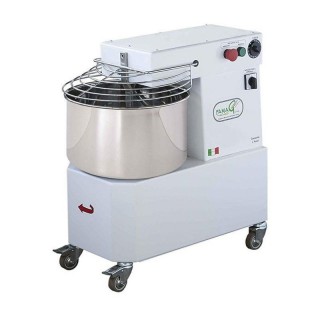
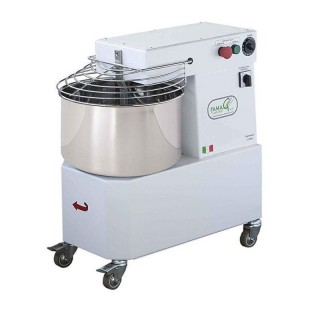
An undersized dough mixer, poor production planning, or unsuitable mixing times can generate consequences that affect the entire working day.
It is no coincidence that many operational issues originate during the very first stage of the production process. In our guide dedicated to professional dough mixers for pizzerias, we explain how properly sizing the equipment can influence the overall organization of the production area.
Storage Area
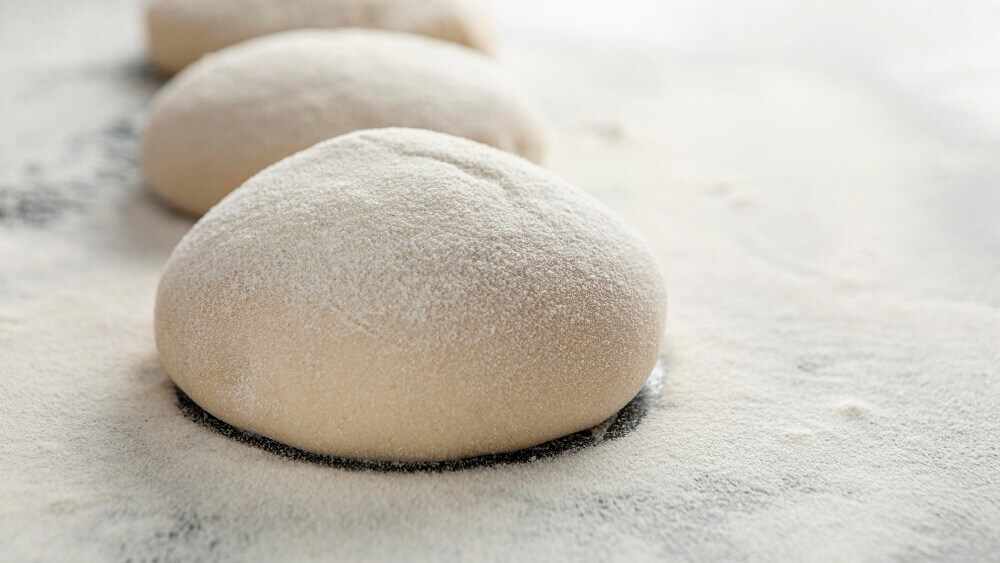
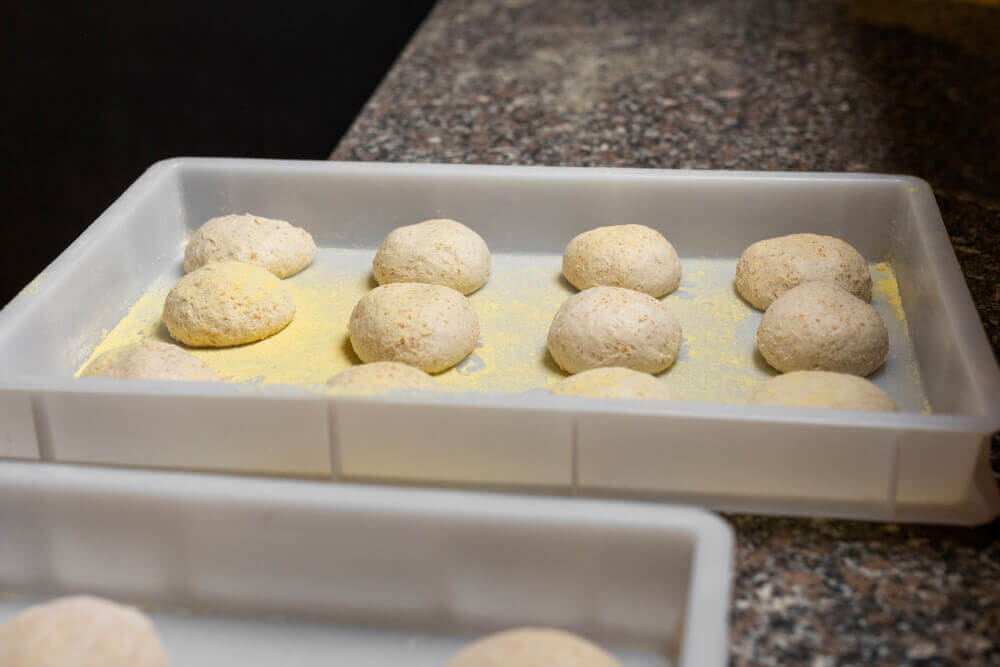
Dough balls and storage containers represent another aspect that is often underestimated.
When staff waste time looking for the correct batch, constantly moving dough trays, or managing poorly organized storage, productivity decreases without the problem being immediately noticeable.
For this reason, proper pizza dough ball management and the organization of pizza dough containers have a much greater impact on service efficiency than many people realize.
Preparation Area
The pizza prep counter is the operational center of the pizzeria.
Every unnecessary movement made during preparation is repeated dozens or even hundreds of times throughout the evening.
An illogical ingredient layout, insufficient workspace, or a poorly organized production line can result in a constant loss of time.
For this reason, proper pizza line organization is often one of the most effective ways to improve productivity.
Baking Area
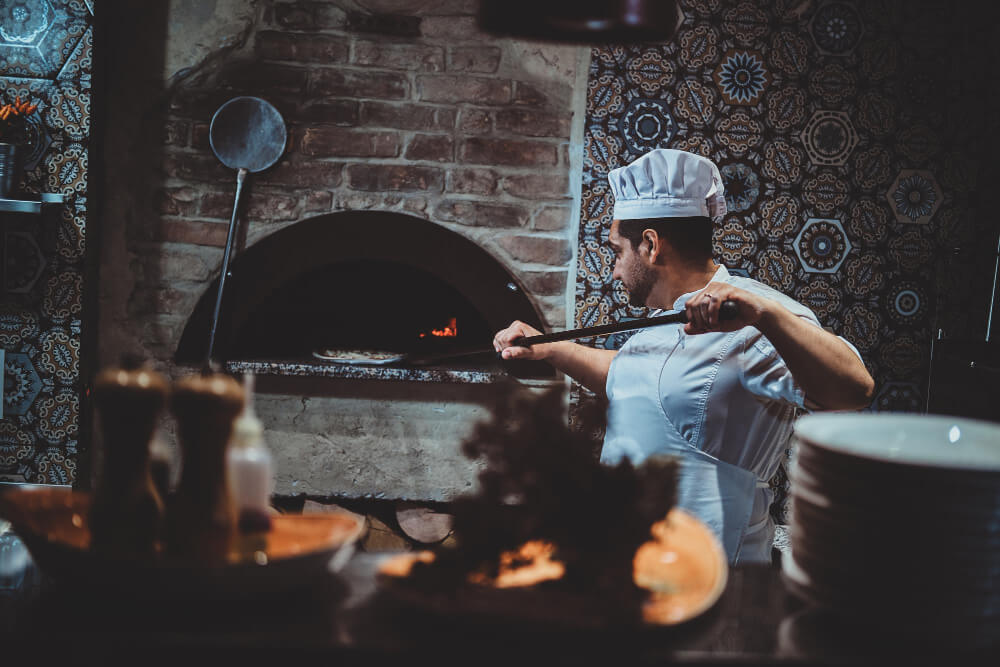
Many operators tend to blame every slowdown on the oven.
In reality, the oven is often simply the point where problems originating in earlier stages become visible.
It nevertheless remains one of the most critical areas of the entire production process. The choice of baking system should always be consistent with the production volume and the overall organization of the pizzeria. To better understand the differences between the available solutions, you may find it useful to read our guide on professional pizza ovens.
The main production inefficiencies generally originate in one of four areas: dough preparation, storage, preparation, or baking.
The Most Common Mistake: Solving the Wrong Problem
One of the most frequent mistakes is trying to solve the symptom rather than the underlying cause.
If the oven is constantly falling behind, it does not necessarily mean that you need a larger oven.
If the pizza maker is under pressure, it does not necessarily mean that you need to hire another employee.
The real issue may instead be inefficient dough ball management, a poorly organized pizza line, or an overall workflow that needs to be redesigned.
This is the same principle discussed in our guide on mistakes to avoid when opening a pizzeria: the most effective decisions always come from analyzing the entire production process rather than focusing only on the final visible problem.
Improving productivity means identifying the real cause of inefficiencies instead of simply dealing with their consequences.
How to Identify Which Area Is Really Slowing Down Your Pizzeria
One of the most common mistakes is evaluating productivity based only on personal impressions. It may seem that the oven is too slow, that the pizza maker spends too much time preparing pizzas, or that hiring additional staff or purchasing new equipment is necessary. In reality, however, the situation is usually far more complex and requires analyzing the entire production process.
The best-organized pizzerias do not simply observe where the problem becomes visible—they try to identify its real cause. A simple method is to analyze where waiting times build up during service.
If pizzas are waiting to be prepared, the bottleneck may lie in the stretching or topping stages. If pizzas accumulate in front of the oven, the baking stage may be the real limitation. When staff lose time before preparation even begins, the issue may be related to dough organization, dough ball management, ingredient layout, or workstation configuration.
In other words, the point where the slowdown becomes visible does not always coincide with the point where it originates.
To identify the real bottleneck, observe where waiting times accumulate during service.
When the Oven Is Not the Problem
The oven is probably the piece of equipment that receives the most criticism in a pizzeria. When service slows down, it is natural to assume that baking capacity is the issue.
In reality, many businesses discover that the oven is simply revealing inefficiencies created during earlier production stages.
For example, the oven may operate only partially because the pizza prep counter cannot supply pizzas continuously. In other situations, the pizza maker is forced to repeatedly interrupt work to retrieve ingredients, dough balls, or utensils, creating delays that inevitably affect the baking process.
In cases like these, investing in a larger or more powerful oven is unlikely to deliver the expected benefits.
For this reason, equipment should always be evaluated within the broader context of the production area's overall organization. In our article dedicated to professional pizza ovens, we explain how the choice of baking system should match the pizzeria's production model rather than simply the number of pizzas you plan to serve.
An underutilized oven is often a sign that inefficiencies exist earlier in the production process.
<>When the Pizza Prep Counter Becomes an Invisible Bottleneck
Many pizzerias invest appropriately in ovens and dough mixers but devote much less attention to the area where the pizza maker spends most of the working day.
The pizza prep counter is the true operational center of production. An illogical ingredient layout, difficult-to-reach containers, insufficient workspace, or inefficient workflows can create constant delays that often go unnoticed.
The reason is simple: these delays do not appear as one obvious problem but are spread across hundreds of small movements repeated throughout the evening. Each movement takes only a few seconds, but together they can have a significant impact on overall productivity.
For this reason, the most efficient pizzerias carefully analyze workstation ergonomics and the operational workflow of the production area. Choosing the right professional pizza prep counters can also help improve comfort, operational continuity, and preparation speed.
Small inefficiencies repeated hundreds of times can have a greater impact on productivity than a single obvious problem.
>When Organization Is More Valuable Than New Equipment
In the foodservice industry, there is a widespread belief that whenever something slows down, the solution is to purchase a new machine.
In some cases, this assessment is correct. Much more often, however, the real issue lies in the organization of the workflow.
Many pizzerias significantly improve productivity by reorganizing workstations, optimizing operational workflows, improving ingredient management, planning production more effectively, or distributing tasks more efficiently among team members.
These improvements generally require limited investment while delivering immediate benefits.
Of course, there are situations in which equipment genuinely represents the production limit. Before investing in new machinery, however, it is always advisable to verify that the real problem is not related to the working method itself.
Increased productivity often results from better organization before it comes from new investments.
Smart Automation: When It Really Helps
In recent years, many pizzerias have introduced equipment designed to standardize certain operations and reduce the time required for repetitive tasks.
This does not mean replacing the pizza maker's expertise, but allowing them to devote more attention to activities that truly require skill, control, and decision-making.
A good example is the professional dough sheeter. Not every pizzeria needs one, and it is not always the right solution. However, when dough stretching becomes a production bottleneck or consumes excessive time during service, this equipment can help improve continuity and operational capacity.
The real question, therefore, is not whether a dough sheeter is useful in general, but whether dough stretching actually represents a bottleneck within your own production process.
In our guide dedicated to professional dough sheeters and the differences between single-roller and double-roller models, we explore this topic in detail.
Automation delivers real benefits only when it addresses a stage that genuinely limits production.
Staff Layout Also Affects Productivity
When discussing efficiency, people tend to focus on equipment, but the staff are an equally important part of the production system.
If two operators constantly cross paths, wait for one another, or share the same workspace, they will inevitably slow each other down. Conversely, a logically designed production area allows every team member to perform their tasks more efficiently and continuously.
The most organized pizzerias define clear workflows, well-identified workstations, and precise responsibilities. Every operator knows which tasks to perform, which tools to use, and which areas they are responsible for.
This approach reduces downtime, misunderstandings, and unnecessary movement, improving the overall flow of service without increasing pressure on the staff.
An inefficient staff layout can limit productivity just as much as undersized equipment.
The Most Productive Pizzerias Do Not Work Faster
One of the most interesting characteristics of the best-organized businesses is that they rarely appear to work frantically.
Their productivity does not come from working faster, but from eliminating the obstacles that interrupt the production flow.
Reducing waiting times, minimizing unnecessary movement, organizing ingredients and equipment efficiently, decreasing errors, and simplifying communication between operators often produce better results than simply trying to increase the pace of work.
Productivity comes from the smoothness of the process and the ability to make every stage predictable, organized, and easily repeatable. This is what enables a pizzeria to grow while maintaining quality, control, and long-term operational sustainability.
The most efficient pizzerias increase productivity by reducing interruptions and making the workflow smoother and more predictable.
Quick Checklist: Is Your Pizzeria Losing Productivity?
Operational inefficiencies are not always immediately visible. Many become part of the daily routine and eventually seem normal, especially when the team still manages to complete the service.
However, there are several warning signs that deserve attention.
If, during service, you frequently notice one or more of the following situations, there may be significant room for improvement:
-
staff constantly walk long distances between workstations;
-
queues form regularly in front of a specific production area;
-
the oven is sometimes waiting for pizzas or becomes a point where work accumulates;
-
ingredients, utensils, or dough balls are frequently searched for during service;
-
some operators are consistently overloaded while others experience downtime;
-
productivity varies significantly from one evening to another;
-
the production area constantly feels rushed, even during normal service periods.
The presence of one or more of these situations does not necessarily mean that you need more equipment or additional staff. In many cases, it simply indicates that some processes can be organized more effectively.
Waiting times, unnecessary movement, and imbalances between workstations are among the main indicators of production inefficiency.
Increasing Productivity Does Not Mean Working Harder
One of the biggest misconceptions in the foodservice industry is that improving productivity means asking staff to work faster.
In reality, the most efficient pizzerias achieve higher production levels because they have removed unnecessary activities that slow down the workflow.
Every unnecessary movement eliminated, every workstation better organized, every ingredient placed in the right position, and every production stage designed according to a logical sequence contributes to improving the overall performance of the business.
This approach also creates a better working environment, reducing stress, minimizing mistakes, and enabling staff to maintain a consistent pace even during the busiest service periods.
Higher productivity comes from better work organization, not from increasing the pace of the staff.
Productivity Is the Result of a Well-Designed Production System
When discussing productivity, many entrepreneurs immediately think about purchasing new equipment.
However, the most productive pizzerias share one common characteristic: they do not consider the dough mixer, pizza prep counter, oven, dough ball management, or staff as separate elements.
They design the entire production area as a single integrated system in which every stage supports the next.
Only after optimizing organization do they evaluate whether investing in new equipment can generate further improvements.
This approach allows businesses to increase production capacity without necessarily increasing operating costs or hiring additional staff.
The most effective investments are those made after identifying the real production bottleneck.
How to Improve Productivity Without Hiring More Staff
Every pizzeria has its own production characteristics, but the method for improving efficiency is always the same.
First, observe the production process carefully. Then identify the stage where work slows down, where waiting times build up, or where operators lose the most time.
Only after this analysis does it make sense to decide whether to reorganize the production area, improve workflows, invest in new equipment, or strengthen the team.
Businesses that follow this method generally achieve better results because they eliminate the real causes of inefficiency instead of simply treating the visible symptoms.
Increasing productivity therefore does not necessarily mean working harder. It means designing a production system that allows every resource—people, equipment, and workspace—to operate in the most efficient way possible.
For this reason, the most successful pizzerias are often not those with the largest teams or the most expensive equipment, but those that have carefully designed every stage of their production workflow.
SHOP NOW: