



















SHOP NOW:


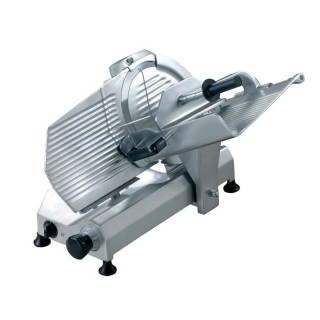
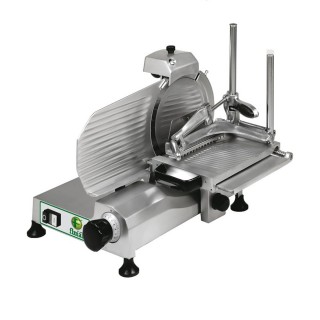
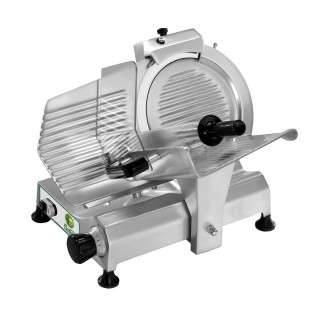


When it comes to professional slicers, blade diameter is one of those aspects that is often chosen “by feel.”
In everyday practice, however, this is exactly the parameter that makes the difference between smooth work and a continuous series of small slowdowns that, by the end of the day, really add up.
It is not a technical detail: it is an operational choice.
Why does blade diameter matter more than you might think?
Blade diameter determines how much product can be sliced without constantly having to reposition it or intervene manually.
With blades that are too small, it is often necessary to “help” the product during slicing, especially with irregular cured meats or cheeses that are not perfectly aged.
These micro-actions, repeated dozens of times, slow down the work and tire the operator.
What really changes in practice between a small and a large blade?
A smaller blade limits the size of the product that can be processed and requires greater attention during slicing.
With larger blades, the product flows more smoothly, the movement becomes more natural, and slicing is more continuous.
This difference is felt most clearly during peak workload moments, when the counter is full and the pace must remain steady.
Blade diameter and work volumes: a direct connection
Blade diameter must be consistent with the laboratory’s real production volumes, not with “ideal” volumes imagined on paper.
An undersized slicer inevitably creates bottlenecks; an oversized one, on the other hand, ends up taking up space and resources inefficiently.
This evaluation fully belongs to the broader reasoning around professional slicers in the design of a food laboratory, where every technical choice must align with overall work organization and real operational flows.

How does blade diameter affect posture and ergonomics?
With smaller blades, the operator is forced to intervene frequently on the product, bend over, and correct its position.
With properly sized blades, movements are more linear and less tiring, especially during repetitive tasks.
These differences do not emerge in the first few days, but after weeks of continuous use.
When does it make sense to compare slicers based on blade size?
Only after clarifying layout, volumes, and product type does it make sense to compare the professional slicers best suited to your laboratory also by blade diameter.
This way, the technical specification stops being just a number and becomes a real working tool.
SHOP NOW:
The right blade is the one that follows the laboratory’s rhythm
The correct diameter is the one that allows work to proceed without forcing and without constant interruptions.
When the blade is properly sized, the slicer disappears from the operator’s thoughts and simply becomes part of the workflow.
That is when the choice has truly been made well.