




















SHOP NOW:
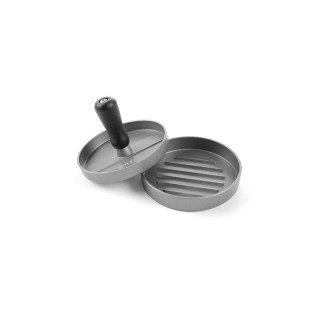



The problem is not the hamburger, it’s the work
At first, in many butcher shops and delicatessens, hamburgers are shaped by hand.
A few pieces, manageable rhythms, direct control over each preparation.
Then the work changes.
Demand increases, hamburgers become a steady production, and the display counter must always be ready. It is at that point that manual shaping begins to slow down the work, even though it still seems like the simplest solution.
This article is not about machines, but about when the working method needs to evolve.
SHOP NOW:
When manual shaping stops being efficient
Shaping hamburgers by hand works as long as:
- volumes are low
- time is not critical
- variability does not create problems
When production becomes daily, however, concrete limitations emerge:
- hamburgers that are all slightly different
- processing times that are difficult to predict
- greater staff fatigue
- portions that are not always consistent
The problem is not manual skill, but the continuous repetition of the same operation.
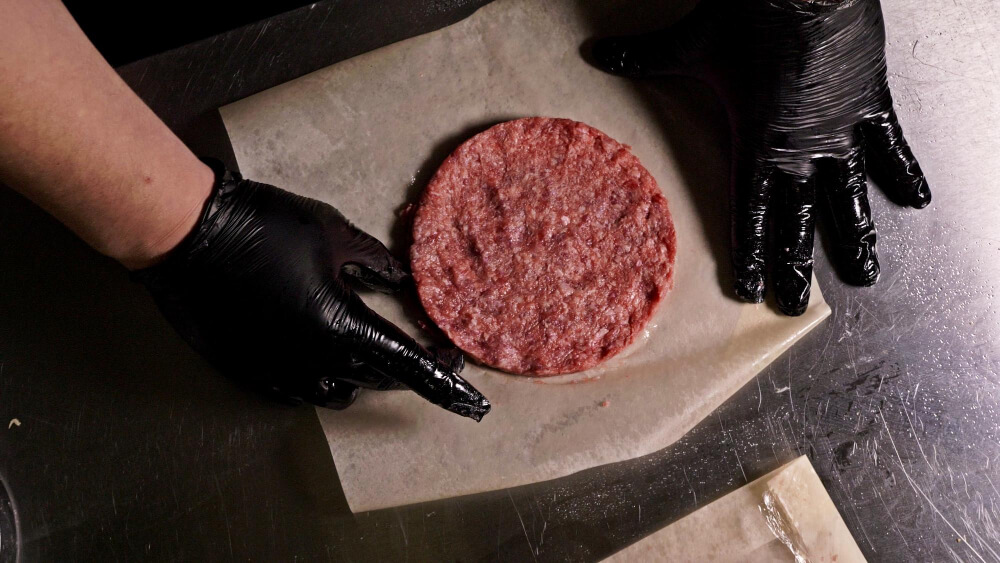
The turning point in the laboratory
Every laboratory reaches a point where a change in approach is needed.
Not because “a machine is needed,” but because the work itself requires it.
This moment arrives when:
- hamburgers are always present in the display counter
- staff must manage multiple processes
- time becomes a critical variable
- weight control becomes important
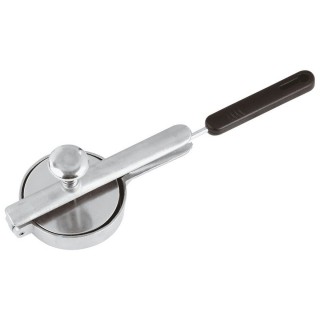
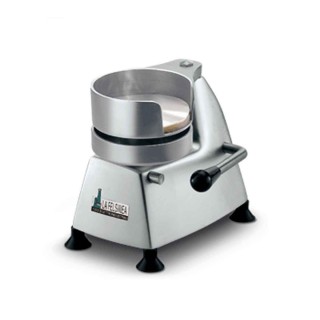
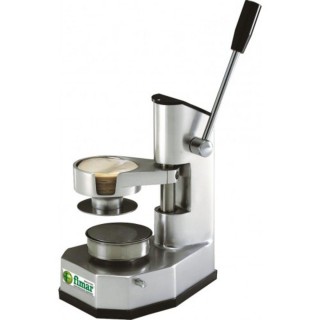
This is where the manual hamburger press comes into play, not as a product, but as a process solution.
What really changes when a hamburger press is introduced
Introducing a manual hamburger press does not mean making “better-looking” burgers.
It means working in a more orderly and predictable way.
The pace changes:
- shaping becomes faster
- timing becomes more consistent
- production can be organized in batches
Control changes:
- more consistent portions
- more stable food cost
- less waste
Perception also changes:
- a more orderly display counter
- a more uniform product
- a stronger sense of professionalism
The hamburger press as part of the workflow
A manual hamburger press is not a stand-alone machine.
It only makes sense if it is correctly integrated into the laboratory workflow.
The process becomes:
grinding → shaping → separation → display or packaging
This logic follows the principles of proper
butcher shop and delicatessen laboratory design,
where each piece of equipment has a precise role and a functional position.
When the workflow is clear, the work runs more smoothly.
Why many businesses start with a manual hamburger press
Many laboratories start with a manual hamburger press because:
- it does not require an electrical connection
- it takes up very little space
- it is immediate and easy to use
- it allows standardization without disrupting the working method
It is a natural transition between fully manual processing and more structured production.
It is not a mandatory choice (and it’s right to say so)
Not all butcher shops need a hamburger press.
If hamburgers are sporadic or marginal, manual shaping may be sufficient.
But when they become:
- a daily production
- a central product
- a significant part of the offering
then the choice is not aesthetic, but organizational.
From problem to solution: where to learn more
After understanding when a manual hamburger press becomes necessary, it makes sense to evaluate which solution is most suitable for your laboratory.
For this reason, there is the professional pressamburger category, which brings together equipment designed for daily use in butcher shops and delicatessens and helps you understand which one to choose.