



















ACQUISTA ADESSO:


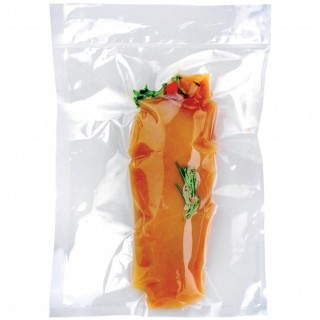



When low-temperature sous-vide cooking is first discussed, it is often assumed that “one bag is as good as another.”
In reality, this is not the case.
Sous-vide cooking bags are a specific technical material.
Using them correctly makes the difference between a controlled process and a risky practice, especially when cooking becomes a stable part of the laboratory’s daily workflow.
Not all vacuum bags can be used for cooking
Bags designed solely for storage are not engineered to withstand heat.
During cooking, they can deform, lose their seal, or, in the worst cases, release unwanted substances.
This is why, in professional environments, sous-vide cooking requires dedicated bags, designed to operate safely even with controlled times and temperatures.
When sous-vide cooking truly becomes part of the workflow
Low-temperature cooking is not a “trial” technique.
It is adopted when working with scheduled preparations, result standardization, and controlled regeneration.
In these cases, bag selection is not a detail but an integral part of the overall organization, to be evaluated together with the
design of the food laboratory,
based on workflows and operational responsibilities.
What sous-vide cooking bags must guarantee
Safe, temperature-suitable materials
Bags must be BPA-free and made from materials suitable for cooking.
This aspect is non-negotiable when sous-vide cooking is used on a continuous basis.
Stability and seal integrity
During cooking, the vacuum must remain stable.
Any loss compromises both the final result and product safety.
Appropriate thickness
The bag must protect the food without hindering heat transfer.
Incorrect thickness alters cooking times, uniformity, and repeatability.
The link between cooking bags and the vacuum machine
Before cooking, there is always a packaging phase.
Compatibility between the bag and the vacuum machine is essential to start with a correct and stable vacuum.
This is the same reason why, even when discussing cooking, it is important to know
how to choose between a chamber vacuum machine and a bar vacuum sealer,
because the technology used affects the quality of the initial packaging.
When vacuum sealing is also used for cooking, attention must be even greater.
Times, temperatures, and materials must be managed consistently within the self-control plan related to
vacuum sealing and food safety,
avoiding improvisation.
Are cooking bags also suitable just for storage?
No.
For storage alone, standard bags selected according to the machine used are sufficient.
Cooking bags should be used only when sous-vide cooking is part of the production process.
To understand which bags to use in other phases, it is useful to correctly distinguish between
embossed and smooth vacuum bags,
based on the vacuum technology adopted.
ACQUISTA ADESSO:
In summary: cooking bags are a tool, not an extra
They are not always needed.
But when they are needed, they are not replaceable.
Integrating them correctly into the workflow means greater control, higher safety, and more consistent results.
And this is what, in practice, makes the difference in a professional laboratory.